


15 Reported Dead, 200 Buildings Threatened as Sand Mining Pushes Anambra Community to the Brink15 15 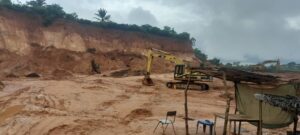
By Our Reporter
For residents of Uga Community in Aguata Local Government Area of Anambra State, the sound of excavators and heavy-duty trucks is no longer simply the noise of economic activity. It has become a reminder of a danger they say is slowly swallowing their homes, roads and livelihoods.
At least 15 people have reportedly lost their lives, while about 200 buildings are said to be exposed to the threat of collapse as sand mining intensifies gully erosion across parts of the community.
In Umudimishi Village, one of the affected areas, residents point to deep gullies cutting through the landscape as evidence of what they describe as years of environmental neglect compounded by aggressive sand excavation.
The community says it has lived with erosion for decades, but residents insist the situation has become far more dangerous since commercial sand mining expanded into areas close to homes.
“We have been victims of gully erosion and since I was born, I grew up to see gully erosion in my town,” said the Chairman of Umudimishi Village, Nze Jude Ibeabuchukwu Ugochukwu.
According to him, Uga currently has about five major erosion sites, some of which originated from neighbouring communities.
He said residents had battled the problem for more than 37 years, with successive governments and community members making efforts to contain it.
But, he alleged, sand mining has now taken the crisis to people’s doorsteps.
“The mining has gotten to residential areas where people are residing like Umudimishi, Awarasi and Agbakuwa villages,” he said.
Ugochukwu claimed that about 200 buildings were currently exposed to erosion, warning that dozens of houses could be destroyed if urgent action was not taken.
“Before the end of this year or by next five months, at least 70 houses would be destroyed by gully erosion caused by the activities of sand mining in our town,” he claimed.
For residents whose houses stand close to the advancing gullies, the fear is not only about losing property. It is about waking up one morning to discover that the ground beneath their homes has given way.
The community leader maintained that the land belongs to Uga and alleged that residents did not authorise the miners to carry out excavation in the affected areas.
He recalled that sand excavation initially involved manual miners known as Morning Star before excavators were introduced.
“Today, the excavators pay N400 per excavator and some money for the youths of our community,” he alleged.
The environmental damage, residents say, is being compounded by the movement of heavy-duty trucks and tippers carrying excavated sand.
They accused the trucks of destroying newly constructed roads, including Obizi Road, Umueze Road, Ugwu-Onyeocha Road to Nkwo-Uga and Awarasi Road.
For the community, it has become a painful cycle: roads built with public funds are damaged by trucks carrying away the sand, while the land left behind becomes vulnerable to erosion.
The human cost, however, is even more disturbing.
The Chairman of Umudimishi Village Youths, Mr Ifeanyichukwu Agbara, alleged that more than 15 people had died in connection with activities around the mining sites.
He claimed that some youths died when mining sites collapsed, while others were allegedly killed when gunmen attacked one of the sites.
“We have like seven youths that have died on the site. Sometime ago, it killed four other people at the same time,” Agbara alleged.
He further claimed that gunmen had previously attacked a mining site, shooting workers and killing about three people.
Beyond the deaths and environmental destruction, Agbara said the sand mining business was also creating tension among youths.
He alleged that a parallel youth organisation had emerged, backed by people benefiting from the mining activities, while some youths were allegedly paid according to the number of tipper loads.
The development, he said, had deepened divisions within the community’s youth structure.
Residents are now appealing directly to Governor Chukwuma Soludo to visit Uga and see the situation for himself.
They want government officials to walk through the affected areas, inspect the erosion sites, assess threatened buildings and determine the extent of damage to roads.
Their plea comes against the backdrop of the Anambra State Government’s reported ban on sand excavation in parts of Aguata and Orumba North and South local government areas.
The state government, through the Commissioner for Environment, Dr Clem Aguiyi, has also established a task force to monitor sand mining activities in affected communities.
For Uga residents, however, the question is no longer simply whether a ban exists.
They want to know whether the ban is being enforced—and whether enforcement will come soon enough to save their homes and prevent more deaths.
They have called for immediate enforcement of the ban on illegal sand mining, rehabilitation of damaged roads and urgent intervention to halt the advance of erosion.
Until then, the gullies continue to widen, the roads continue to deteriorate and families living close to the mining sites remain anxious about what the next heavy rainfall—or the next excavation—could bring.
