


 Ebola Alert: When Fever, Weakness and Body Pains Become a Public Health Concer
By Our Correspondent
A sudden fever, a severe headache and unusual weakness may appear to be symptoms of a familiar illness in a country where malaria and other infections are common.
But amid Nigeria’s confirmation of an imported Ebola case in Abuja, these seemingly ordinary complaints have taken on a renewed public health significance.
For many families, the challenge is knowing when an illness requires urgent medical attention, particularly when its early symptoms resemble those of more common diseases.
Ebola is a severe infectious disease that can progress rapidly.
The World Health Organisation says symptoms may begin between two and 21 days after exposure to the virus, with fever, fatigue, muscle pain, headache and sore throat among the initial warning signs.
As the illness progresses, patients may develop vomiting, diarrhoea, abdominal pain and skin rash. Some may experience bleeding, although bleeding is not present in every case.
The similarity between Ebola’s early symptoms and those of malaria, typhoid and other infections makes it difficult for people to identify the disease by appearance alone.
Laboratory testing and professional medical assessment are required for confirmation.
A confirmed case raises fresh concerns
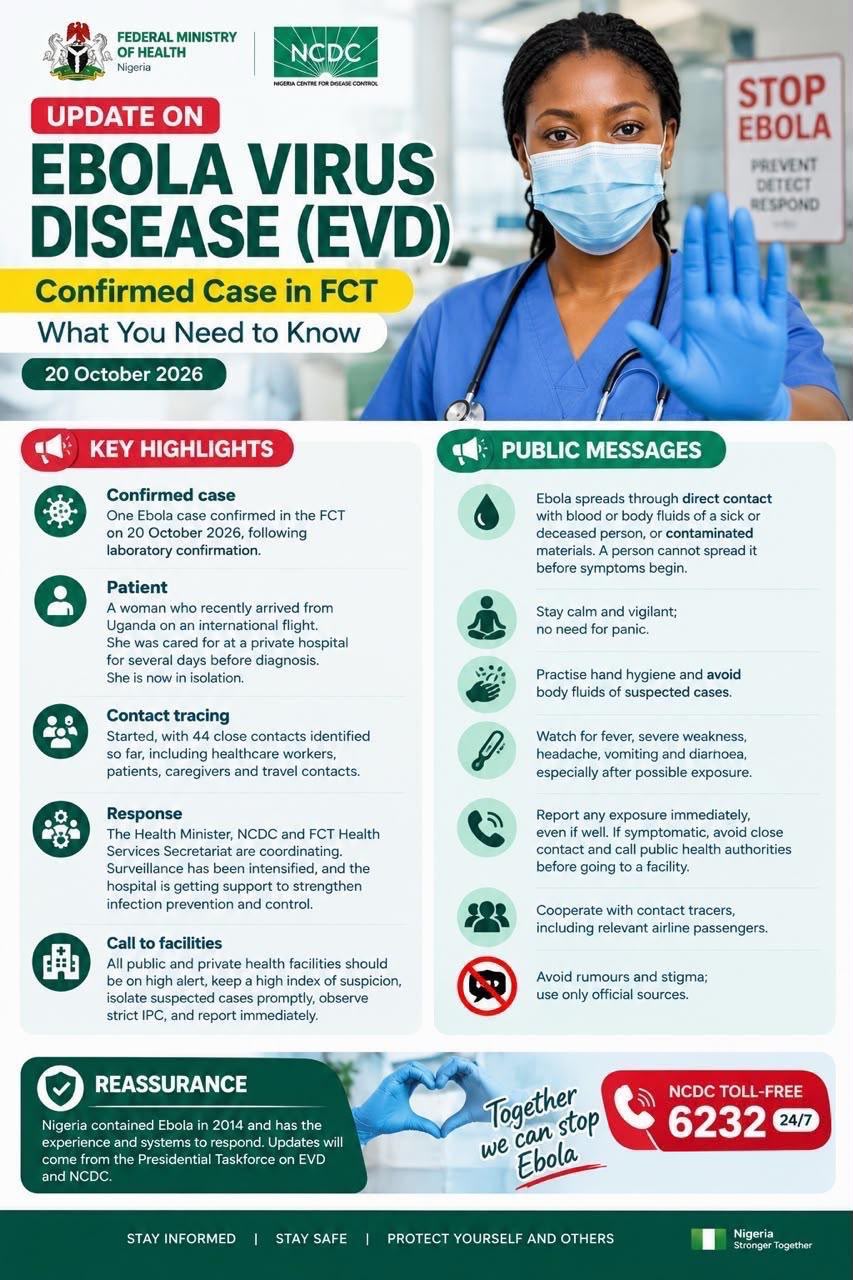
Nigeria’s Federal Government confirmed an imported case of Ebola disease in the Federal Capital Territory on October 20, 2026.
According to the Federal Ministry of Health and Social Welfare and the World Health Organisation, the patient is a woman with a recent travel history involving Uganda.
Her symptoms reportedly began on October 7, and she sought treatment at a private health facility in Abuja on October 11.
Laboratory testing subsequently confirmed infection with the Bundibugyo virus, a type of Ebola virus.
The patient has been placed in isolation and is receiving medical care.
Authorities have identified 44 contacts for monitoring, while public health teams continue investigations to establish the likely source of infection and identify other people who may have been exposed.
The development has renewed the importance of public awareness, early reporting and effective infection prevention, especially among healthcare workers and people who may have had direct contact with an infected patient.
The warning signs families should know
The first signs of Ebola may not immediately appear unusual.
A person may suddenly develop fever, chills, muscle and joint pains, headache, sore throat, weakness and loss of appetite.
As the illness worsens, gastrointestinal symptoms such as nausea, vomiting, severe diarrhoea and abdominal pain may emerge.
Other possible complications include chest pain, difficulty breathing, red eyes, skin rash and, in some cases, unexplained bleeding.
Health experts caution that families should not wait for the appearance of bleeding before seeking medical attention.
It is not a universal symptom, and waiting for it could delay the assessment of a seriously ill person.
Equally, having a fever or body pains does not automatically mean someone has Ebola.
The symptoms occur in several other illnesses, and the person’s travel history, possible exposure and clinical condition are important in determining the appropriate medical response.
How the virus spreads
One of the most important facts about Ebola is that it does not spread in the same way as common respiratory infections such as influenza.
According to the WHO, transmission occurs mainly through direct contact with the blood or other body fluids of an infected person who has developed symptoms, or through objects contaminated with those fluids.
People may also become infected through contact with infected animals. Handling the bodies of people who have died from Ebola without appropriate protective measures can also expose others to the virus.
A person infected with Ebola is not considered infectious before symptoms begin.
Simply passing an infected person in the street or being near someone without exposure to infectious body fluids does not ordinarily transmit the disease.
This distinction is important because misinformation can create unnecessary panic, encourage discrimination and prevent people from seeking reliable medical advice.
What families should do
For families, the first response to a suspected case should be caution rather than panic.
Anyone who develops compatible symptoms after a possible exposure should contact a healthcare facility or public health authority immediately and explain the exposure history.
They should call ahead before travelling to a hospital so that appropriate precautions can be arranged.
People should avoid direct contact with the sick person’s blood, vomit, stool and other body fluids.
They should also avoid handling contaminated clothing, bedding or other materials without appropriate protective equipment.
Family members should not attempt to diagnose Ebola at home or rely on traditional remedies as a substitute for professional assessment.
Healthcare workers, meanwhile, must maintain strict infection prevention and control procedures, promptly report suspected cases and follow public health guidance.
Beyond fear: The need for public awareness
Nigeria has previous experience managing Ebola, including the 2014 outbreak response.
However, preparedness depends on timely detection, effective contact tracing, properly equipped health facilities and public cooperation.
The confirmation of a case in Abuja makes accurate information particularly important.
Rumours about suspected cases should not be circulated as established facts, and people who may have been exposed should be treated with dignity while following official health instructions.
Public awareness must also reach communities outside major cities, where access to reliable health information and emergency services may be limited.
For ordinary Nigerians, the message is straightforward: fever, weakness and body pains are not proof of Ebola, but symptoms following a possible exposure should never be ignored.
Early medical assessment, responsible reporting and avoiding contact with potentially infectious body fluids remain essential steps in protecting individuals, families and communities.
As health authorities work to contain the confirmed case, public vigilance must be matched with reliable information, compassion and confidence in evidence-based medical care.
Sources: World Health Organisation; Federal Ministry of Health and Social Welfare; US Centers for Disease Control and Prevention.
