


Decades of Agitation, Two Court Cases: Bayelsa’s Search for Resource Control and More LGA

By Peace Osigwe
For decades, the demand for resource control has remained one of the defining struggles of the Niger Delta, a region whose oil and gas wealth sustains a significant part of Nigeria’s economy, yet whose communities continue to grapple with environmental degradation, unemployment and inadequate infrastructure.
For some veterans of the Ijaw struggle, the agitation has become more than a political slogan.
It is a question of whether communities that produce the nation’s wealth can finally secure greater control over their resources and a fair share of the benefits.
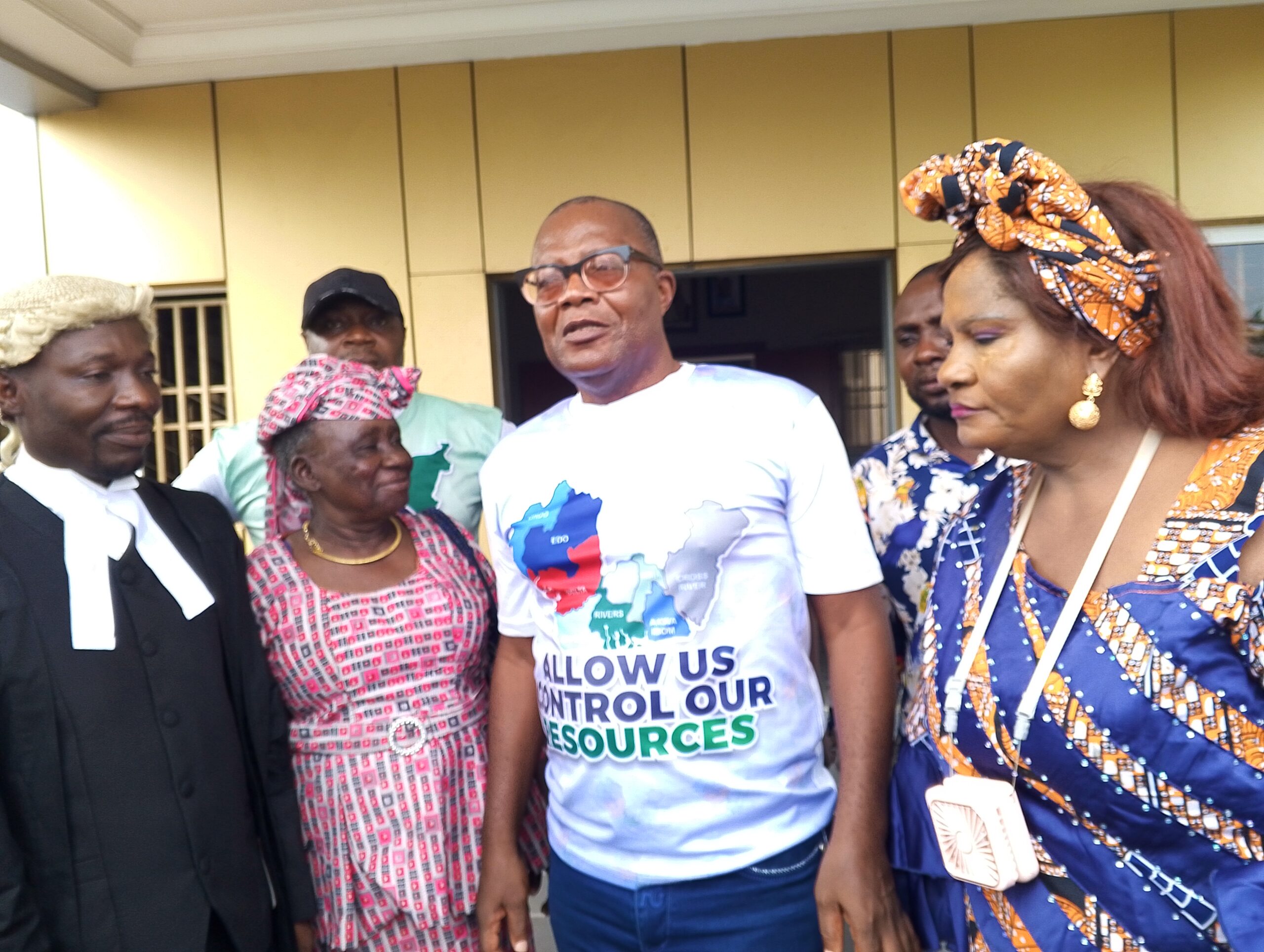
Now, rather than return to the streets, members of the Supreme Egbesu Assembly (SEA) have taken their demands to the courtroom, hoping that the judiciary will provide answers to two issues they consider fundamental to Bayelsa State and the wider Niger Delta: resource control and the creation of additional local government areas.
But months after the suits were initiated, the applicants are still waiting for the legal battle to progress, with another adjournment by the Federal High Court in Yenagoa raising concerns about how long the disputes may take to resolve.
From street protests to the courtroom
The Supreme Egbesu Assembly’s decision to seek judicial intervention reflects a transition from years of agitation and public demonstrations to a constitutional battle.
The group’s Secretary-General, Dr Felix Tuodolo, said its members had spent years demanding resource control and additional local government areas for Bayelsa, with some participants in the struggle paying a heavy price.
According to him, successive governments have failed to adequately address the demands, prompting the group to pursue legal remedies.
“We are here today because we have not been listened to over the years on two major issues—resource control and the creation of more local governments for Bayelsa State,” Tuodolo said during an earlier court appearance.
He described members of the group as veterans of the Ijaw struggle who had marched through Yenagoa, Port Harcourt and Warri to press their demands.
For them, the courtroom represents another avenue to seek redress after years of protests and advocacy.
Tuodolo warned that the grievances should not be ignored, arguing that continued frustration could affect how younger generations respond to the region’s longstanding challenges.
His position underscores the broader human dimension of the dispute: beyond constitutional provisions and legal arguments are communities seeking economic opportunities, better public services and a stronger voice in decisions affecting their future.
Two suits, one demand for a fairer arrangement
The Assembly is pursuing two separate cases against the Federal Government and the National Assembly at the Federal High Court in Yenagoa.
The first, marked FHC/YNG/CS/63/2026, concerns resource control and the constitutional arrangement governing the ownership and management of Nigeria’s natural resources.
The applicants are seeking a system that would give states greater control over their resources while requiring them to remit an agreed percentage of revenue to the Federal Government.
Their counsel, Barrister E. Kenneth Okorodas, said the resource control suit was founded on the 1999 Constitution of the Federal Republic of Nigeria, as amended.
He referred to Section 162(2), which deals with the distribution of revenue from the Federation Account, and argued that the existing arrangement should be examined against the principles of equitable federalism.
The applicants maintained that resource-producing states should have greater authority over their natural endowments and the opportunity to determine their development priorities.
The second suit, FHC/YNG/CS/64/2026, concerns the creation of additional local government areas in Bayelsa State.
The Assembly had sought an order compelling the National Assembly to create additional local government areas for the state.
An earlier report described the demand as one for 24 additional councils, while the applicants’ counsel later disclosed that an amendment had been made to reflect a position providing for 33 local government areas rather than the 24 cited in an earlier arrangement.
The precise scope and legal implications of the amended claim remain matters for the court to determine.
For the applicants, however, both cases are connected by a common argument:
Bayelsa and its people should receive a fairer opportunity to benefit from the state’s resources and participate in the country’s political and economic arrangements.
The cost of waiting for justice
The latest proceedings have brought the question of delay to the forefront.
The Federal High Court sitting in Yenagoa adjourned the two suits on October 26, 2026, to November 12, 2026, for further hearing.
The cases came up before Justice N. Ayo Emmanuel, but the non-appearance of counsel for the National Assembly prompted the adjournment.
The judge directed that efforts be made to ensure the legislature’s legal representative appeared at the next sitting.
After the proceedings, Tuodolo accused the National Assembly and the Federal Government of delaying the determination of the cases.
He said the applicants had consistently attended court with their lawyers whenever the matters were scheduled, while the National Assembly’s counsel had yet to appear since the cases resumed.
Tuodolo also disclosed that the Ministry of Justice appeared in court for the first time during the latest sitting.
“We have been coming every time the case has been scheduled with our lawyers. They have not been coming. They have been using delay tactics,” he said.
The allegation reflects the applicants’ frustration, although the absence of counsel alone does not establish that the defendants deliberately sought to frustrate the proceedings.
Okorodas was more cautious in his assessment, declining to speculate on whether the National Assembly’s repeated absence was intentional.
He explained that the court had to balance the applicants’ desire for a timely determination with the legal requirement that all parties be given a fair hearing.
According to him, the parties had filed processes in the resource control case, including the applicants’ replies, and the matter could ordinarily have proceeded to the adoption of briefs before judgment was reserved.
However, the court considered it necessary to give the National Assembly an opportunity to file its processes.
The lawyer said the legislature would have to seek an extension of time if it intended to file its response outside the prescribed period, while the applicants could challenge the reasons advanced for the delay.
The distinction is important. While the applicants are concerned about repeated adjournments, the court must ensure that the eventual decision is reached through a process that respects the rights of all parties.
When resource wealth does not translate into development
For Tuodolo, the dispute is not simply about constitutional interpretation. It is also about the contrast between the resources extracted from the Niger Delta and the conditions in which many communities live.
He cited gas development projects and the movement of the region’s natural resources to other parts of the country, arguing that the resulting economic benefits have not adequately addressed local needs.
He also pointed to inadequate roads and other infrastructure as evidence of what he considers an imbalance in national development priorities.
The Lagos-Calabar Coastal Highway became a particular reference point in his criticism, with Tuodolo arguing that oil-producing communities in the Niger Delta also deserved substantial investment in road networks and public infrastructure.
“If it is difficult for you to build roads in that terrain, why is it not difficult for you to go to that very terrain to collect their resources?” he asked.
His question captures a longstanding grievance in the oil-producing region: communities often see the extraction of petroleum resources as evidence that their difficult terrain can be accessed when national economic interests are at stake, yet they continue to demand roads, environmental remediation and other basic amenities.
The applicants also argue that the consequences of oil and gas extraction—including environmental damage and limited economic opportunities—make a stronger case for a system that gives producing states greater control over their resources.
Their position is that resource control could allow states to direct more resources towards local priorities, including infrastructure, employment and environmental recovery.
Whether the constitutional arguments advanced by the applicants will succeed is a matter for the court, but the grievances they have raised reflect issues that have remained central to debates about development and federalism in the Niger Delta.
The local government question
Alongside resource control, the demand for additional local government areas raises questions about political representation, administrative reach and the distribution of public resources in Bayelsa.
For the applicants, creating more councils is part of a broader push for what they consider fairer representation and a more responsive system of local administration.
However, the creation of additional local government areas is not simply an administrative decision.
It raises constitutional and legal questions concerning the procedures and institutions empowered to establish local government areas and give them formal recognition.
The court will therefore have to consider the legal basis of the applicants’ demands and the reliefs sought in the amended suit.
The outcome could have implications beyond the immediate parties, particularly for discussions about local governance and the constitutional position of states seeking changes to their local government structures.
For Bayelsa residents, the broader question is whether any eventual changes would translate into more effective administration, improved access to public services and greater development at the grassroots.
“We want judgment”
Despite the repeated adjournments, the applicants say they remain committed to the legal process.
Tuodolo insisted that the Assembly was seeking a favourable judgment rather than compensation.
“We want judgment. We want to win this case,” he said.
The statement reflects the group’s determination to secure a judicial pronouncement on issues it believes have remained unresolved for too long.
Okorodas said the court would ultimately determine the merits of the arguments presented by the parties, expressing confidence that the judiciary would provide clarity on the constitutional questions raised.
The applicants include Tuodolo, Weri Digifa, Ebi Waribigha, Kabowei Akambe, Rosebella Jackson, Thomas Jacklloyd, Primrose Kpokposei, David Imole and Welma Warri.
The next sitting, scheduled for November 12, 2026, will be another opportunity for the parties to advance the cases.
A judgment that could shape a wider debate
The significance of the suits extends beyond the immediate demands of the Supreme Egbesu Assembly.
Resource control has long featured in Nigeria’s debates over fiscal federalism, revenue allocation and the relationship between resource-producing communities and the Federal Government.
At the heart of the debate is a difficult question: how can the country balance national revenue needs with the development priorities and expectations of the states and communities from which its natural resources are extracted?
The Bayelsa cases bring that question before the courts, alongside a separate demand for additional local government areas.
For the applicants, a favourable judgment would represent a major step towards addressing grievances they say have persisted for generations.
For the wider public, the cases will test the legal arguments surrounding resource governance and local government creation, even as the broader political debate continues.
Until the court reaches a determination, the applicants must wait.
For people who say they have spent decades demanding greater control over their resources and fairer representation, the coming hearing is more than another date on the court calendar.
It is another opportunity to move longstanding grievances from public agitation towards a legal resolution.
