


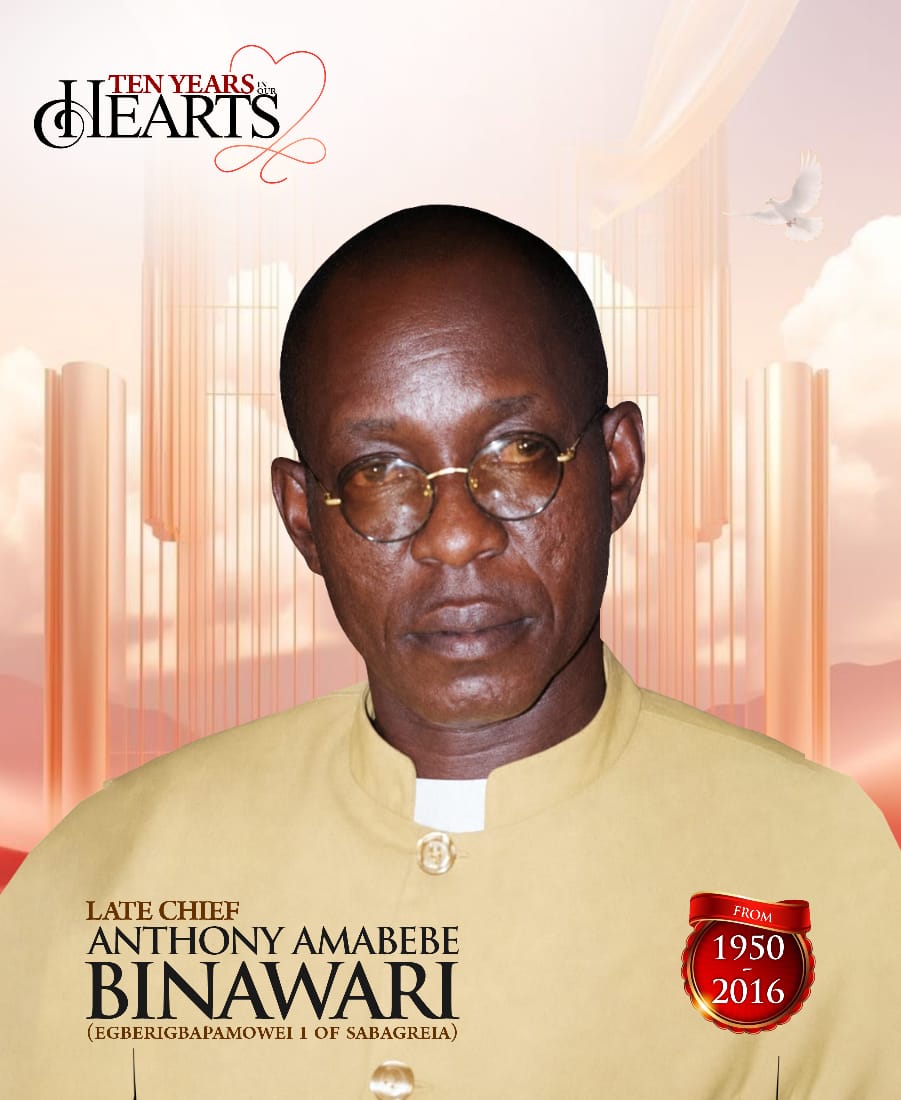
REMEMBERING A MEDIA COLOSSUS: CHIEF ANTHONY AMABEBE BINAWAR
“People will forget what you said, people will forget what you did, but people will never forget how you made them feel.” — a quote widely attributed to Maya Angelou.
These timeless words aptly capture the life and legacy of an extraordinary broadcaster whose voice transcended the airwaves to become a trusted companion in countless homes.
Chief Anthony Amabebe Binawari belonged to that rare breed of media professionals whose presence behind the microphone elevated broadcasting into an enduring art.
Every programme he anchored bore his unmistakable stamp of excellence, leaving audiences informed, inspired, entertained and eagerly anticipating his next appearance.
Born on November 9, 1950, in Sabagreia, Kolokuma/Opokuma Local Government Area of present-day Bayelsa State, Chief Tony Binawari was raised in a disciplined and hardworking family.
He was the first of twelve children born to Mr. Jonathan Atkins Binawari—a seaman, merchant and police officer—and Mrs. Celina Binawari, a successful businesswoman.
His educational journey began at Methodist Primary School, Surulere, Lagos, before he proceeded to Nigerian People’s High School, Ebute-Meta, laying the foundation for a lifetime of service and excellence.
His patriotism manifested early. At the outbreak of the Nigerian Civil War, he enlisted in the Nigerian Army without informing his father.
Although his enlistment was later withdrawn by his father, himself a veteran of the Second World War, the episode reflected remarkable courage and an unwavering willingness to serve a cause greater than himself. That same spirit would later define a broadcasting career anchored on truth, public accountability and societal progress.
Seeking broader opportunities, Chief Binawari relocated to Port Harcourt, where he briefly worked with the Rivers State Newspaper Corporation before discovering his true calling in broadcasting. In 1977, he joined the Rivers State Broadcasting Corporation as a Presentation Assistant.
Through diligence, professionalism and exceptional talent, he steadily rose through the ranks, becoming Controller of Outside Broadcast in 1993 and earning widespread respect from colleagues and audiences alike.
The creation of Bayelsa State marked another defining moment in his career. As one of the pioneering broadcasters who returned home to help establish Radio Bayelsa, now Glory FM, Chief Binawari became one of the station’s earliest voices and one of its strongest pillars.
Rising to the position of Director of Programmes, he also supervised the Sports, Drama and Outside Broadcast departments, helping to shape the professionalism, credibility and identity of public broadcasting in Bayelsa State. The standards he established continue to influence the industry today.
Beyond broadcasting, Chief Binawari was an outstanding labour leader. His unwavering commitment to workers’ welfare earned him an election as National Vice President (Eastern Zone) of the Radio, Television, Theatre and Arts Workers Union of Nigeria (RATTAWU).
He also played a pivotal role in strengthening the union and facilitating the inauguration of the Bayelsa State Council in 1998.
His pursuit of excellence extended beyond the newsroom.
He obtained a Bachelor of Science degree in Government and Public Administration from Imo State University, Owerri, while continually improving himself through numerous professional courses, workshops and seminars.
What truly distinguished Chief Binawari, however, was not merely the offices he occupied but the influence he wielded through responsible journalism. His legendary co-presentation of How Is Your World? alongside Florence Ekive became one of the Niger Delta’s most respected public affairs programmes.
The programme evolved into a powerful platform for public accountability, exposing institutional failures and drawing urgent attention to issues requiring government intervention. His popular segment, The Snippet, earned him the nickname “The Snoop” because of his fearless yet balanced commentary on public affairs.
Such was the programme’s influence that successive military administrators and elected governors reportedly monitored it closely, often directing immediate action on issues raised during its broadcast.
Upon joining Radio Bayelsa, he recreated the same culture of fearless, responsible and impactful broadcasting through programmes such as The Way It Is and What Is in a Name, the latter co-hosted with the late Samuel Isenah.
These programmes demonstrated that broadcasting could simultaneously educate, inform, entertain and inspire meaningful social change.
Recognition naturally followed excellence. Throughout his distinguished career, Chief Binawari received numerous awards from professional associations, humanitarian organisations, the National Youth Service Corps Anti-HIV/AIDS Club, the Federal Road Safety Corps, Rotary International, Bayelsa State Broadcasting Corporation, Bayelsa Media Awards and several other institutions in recognition of his immense contributions to journalism, public enlightenment and community development.
Yet, perhaps his greatest honour was not the plaques or certificates he received, but the enduring trust and affection he earned from the people whose lives he touched through the microphone.
Fondly known as “Egbon,” “Oloye,” and the “Larry King of Bayelsa”—a title bestowed on him by renowned playwright and literary icon Nengi Joseph Ilagha—Chief Binawari embodied humility, warmth and professional excellence. He mentored generations of broadcasters, generously sharing his vast knowledge and experience with younger practitioners.
Away from the studio, he was an avid football enthusiast, a devoted Arsenal supporter, a lover of country music, an adventurer, a respected traditional chief and the Chief Spokesman of the Sabagreia Council of Chiefs, holding the revered title of Egberigbapamowei I of Sabagreia.
Retirement never diminished his passion for broadcasting. Even in his final days, his radio remained within reach as he listened attentively to broadcasts, offering thoughtful observations and constructive corrections with the same commitment that had defined his remarkable career.
On the quiet morning of July 10, 2016, following a brief illness, Chief Anthony Amabebe Binawari answered the final call at the Federal Medical Centre, Yenagoa.
He left behind his beloved wife, Mrs. Ann Binawari, children, grandchildren, siblings, relatives, countless protégés and an entire generation of media professionals whose careers continue to reflect his enduring influence.
A decade has now passed since the curtain fell on his extraordinary earthly journey, yet the echoes of that unforgettable voice remain alive. The microphone may have fallen silent, but the message endures.
The studio lights may have dimmed, but his legacy continues to illuminate the path of those who believe journalism is a sacred trust rather than merely a profession.
Chief Tony Binawari was far more than a broadcaster. He was the conscience of the airwaves, the voice of his community, a fearless advocate for accountability and a compassionate leader whose influence reached far beyond the walls of the studio.
Time may dim memories, but genuine greatness defies the passage of years. It lives on in the standards established, the institutions strengthened, the lives transformed and the countless people inspired.
Ten years after his passing, Chief Anthony Amabebe Binawari remains a timeless symbol of integrity, professionalism and selfless service.
Though his voice is no longer heard on the radio, it continues to resonate through every broadcaster who values truth, every journalist who chooses courage over convenience and every listener who believes that words spoken with conviction and purpose possess the power to transform society.
May the distinguished:
Egberigbapamowei I of Sabagreia, the unforgettable Larry King of Bayelsa, continue to rest in eternal peace. Though absent in body, his legacy remains alive and will never be silenced.
