


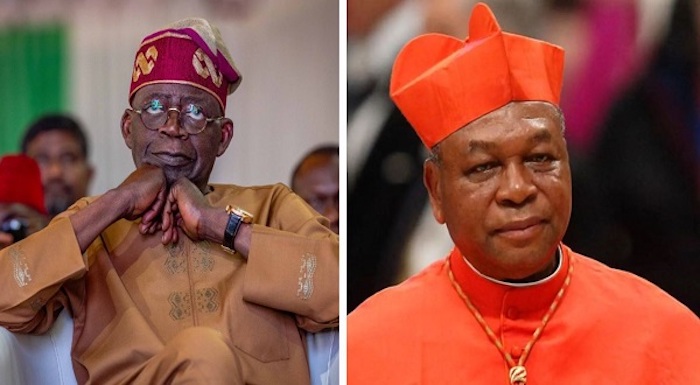
2027: If Nigerians Believe APC Will Win Anyway, They May Boycott Polls – Cardinal Onaiyekan By Our Correspondent
The Archbishop Emeritus of Abuja, John Cardinal Onaiyekan, has warned that voter turnout in the 2027 general elections could decline sharply if Nigerians believe the outcome is predetermined in favour of the ruling APC.
Speaking on Monday during an interview on Frontline, a current affairs programme on Eagle 102.5 FM in Ilese-Ijebu, Ogun State, Onaiyekan said such a perception would discourage citizens from voting and weaken the legitimacy of any government produced by the election.
“My fear is that if it becomes very clear to Nigerians that no matter what happens, the APC will win, then most people won’t even bother to go to the election. And even if the government, the real power wins, it will not bring a real victory actually. And it is not going to be possible to deliver a good government,” he said.
The cleric stressed that restoring public confidence in the electoral process is essential for democracy to thrive, insisting that only free, fair and credible elections can produce good governance.
According to him, increasing voter apathy in recent elections reflects widespread distrust in the electoral system, a challenge he said must be addressed before the next general election.
“Genuine democracy is built on free and fair elections. Any democracy that cannot do free, fair and credible elections cannot come up with good governance. Elections have consequences. Bad elections lead to bad governance and bad governance leads to misery among the people,” he said.
Onaiyekan maintained that Nigeria has yet to conduct a truly free and fair election, urging the government to rebuild public trust in the electoral process.
“I think it is in our interest, and the government, which has all the powers, should ensure that the trust of the people in the electoral process is restored, so that we can get at least 50 per cent of Nigerians voting. If the electoral field is seen to be fair and equal for everybody, then people will know that their votes will count,” he added.
Comparing democracy with military rule, the Cardinal noted that elected governments derive legitimacy from the people and must remain accountable through periodic elections.
“When we were under military rule, we didn’t talk about elections and the military rulers never claimed they were governing in our name. But now, under democracy, those in power say they are ruling on our behalf. We cannot keep quiet when people claiming to represent us fail to do so,” he said.
Drawing comparisons with the United Kingdom, Onaiyekan argued that peaceful alternation of power strengthens democratic institutions and national development.
Responding to claims that the President had defended the neutrality of the Independent National Electoral Commission, he said credible elections depend not only on the electoral umpire but also on the conduct of security agencies.
“Even if INEC is neutral, election outcomes are also influenced by the activities of security agents, who often intimidate voters with heavy deployments and sirens, something that does not happen in established democracies,” he said.
On the August 15 Osun State governorship election, where he recently led the National Peace Committee in facilitating the signing of a peace accord among political parties, Onaiyekan acknowledged that such agreements have often failed to prevent violence but described them as important moral commitments.
“From the very beginning, every peace accord facilitated by the National Peace Committee has been an act of faith.
We always hope they will make a difference, but unfortunately, events on the ground have often gone contrary to the commitments made by the parties,” he said.
