


When Representation Becomes a Question of Belonging: Bayelsa East, Yenagoa and the Politics of InclusionBy Crystalnews
For many residents of my Bayelsa East and parts of Yenagoa Local Government Area, the question is no longer simply about who occupies a particular political office.
It is about whether their voices are being heard where the state’s most important political decisions are made.
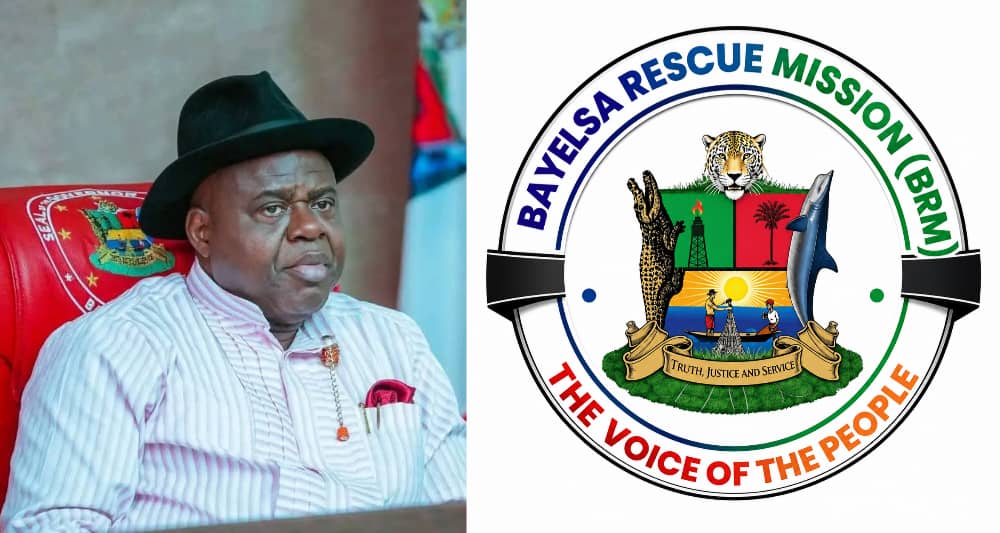
That question has now been brought into sharper focus by the Bayelsa Rescue Mission (BRM), which has accused the administration of Governor Douye Diri of allegedly marginalising Bayelsa East Senatorial District and significant sections of Yenagoa LGA in the distribution of key political appointments and positions within the ruling party.
For the people at the centre of the controversy, the issue goes beyond the usual competition for political appointments. It touches on a deeper feeling of inclusion—or exclusion—in the affairs of a state where political representation has historically been closely tied to the three senatorial districts.
Bayelsa East comprises Brass, Nembe and Ogbia local government areas, while Yenagoa, the state capital, brings together communities including Epie/Atissa, Okordia, Biseni, Zarama and Gbarain/Ekpetiama.
The BRM argues that these areas cannot be regarded as peripheral to the political and economic life of Bayelsa.
In a statement signed by its Publicity Secretary, Hon. Kalas Agai Nimitenbofa, the group called on Governor Diri to urgently review what it described as an imbalance in the current political structure.
Its argument is straightforward: government belongs to everybody, and every part of the state should have a reasonable opportunity to participate in the decisions that shape its future.
A state built around political balancing:
Since the creation of Bayelsa State in 1996, political balancing among its different ethnic, senatorial and local government constituencies has remained an important consideration in the state’s politics.
With only eight local government areas and a population spread across riverine communities, political appointments often carry significance beyond the title attached to the office.
They can become symbols of recognition, influence and belonging.
This is why the composition of the political leadership around a governor is closely watched.
According to the BRM, the early years of the Diri administration offered a measure of geographical balance.
When the administration began in 2020, the group recalled that the Secretary to the State Government, Rt. Hon. Konbowei Benson, was from Southern Ijaw in Bayelsa Central, while the Chief of Staff, Chief Benson Agadaga, came from Ogbia in Bayelsa East.
The Deputy Chief of Staff was from Sagbama in Bayelsa West, while the Principal Secretary was from Kolokuma/Opokuma. The Political Adviser was also from Sagbama.
To the BRM, the arrangement allowed different parts of the state to see themselves in the administration.
But the group believes that balance changed as vacancies emerged and appointments were subsequently made.
The resignation of the SSG and Chief of Staff to pursue their senatorial ambitions, according to the group, created openings that could have altered the political equation.
While the SSG position remained with Southern Ijaw, the Chief of Staff position previously occupied by an Ogbia indigene was filled by Dr. Peter Akpe from Sagbama.
The BRM said the Principal Secretary’s office was later scrapped, with its occupant, Mr. Irorodamie Komonibo, elevated to Deputy Chief of Staff.
When Akpe subsequently became Deputy Governor, the Chief of Staff position again became vacant.
For the BRM, that vacancy represented another opportunity to restore Bayelsa East to what it considers an important position within the administration’s inner political circle.It alleges that this has not happened.
‘Where is our place?’
At the heart of the controversy is a question that is less bureaucratic than emotional: Where do we belong?
The BRM believes that residents of Brass, Nembe, Ogbia and Yenagoa have legitimate reasons to ask whether they have adequate representation around the table where major political decisions are taken.
The group specifically pointed to what it described as the governor’s “inner circle” of political consultation, arguing that the Governor himself is from Kolokuma/Opokuma, the Deputy Governor from Sagbama, the Secretary to the State Government from Southern Ijaw, the Chief of Staff from Kolokuma/Opokuma, while the leadership of the ruling party is also concentrated outside Bayelsa East.
The BRM asked: “Where is the place of Bayelsa East in the highest level of political decision-making in the state? Where is the place of Yenagoa Local Government Area?”
Those questions resonate because political appointments are not merely about offices.
In communities where government appointments can determine who has access to the governor, who can influence policy and whose concerns reach the highest level of government, the absence of a representative from a particular area can easily be interpreted as political exclusion.
Beyond appointments:
The BRM insists that its demand should not be misunderstood as a call for government positions to be shared mechanically according to senatorial districts or local government areas.
Rather, it wants what it describes as fairness, equity and inclusion.
That distinction is important.
A government cannot realistically appoint representatives from every community to every strategic position.
But political inclusion can also be demonstrated through consultation, party leadership, advisory structures and the deliberate involvement of different constituencies in decision-making.
For Bayelsa East, the argument is particularly significant because of the district’s economic importance.
Brass, Nembe and Ogbia occupy important positions in the state’s oil and gas economy and its maritime environment.
Their communities have contributed significantly to the state’s revenue base and economic development.
Yenagoa, meanwhile, is not only a local government area. It is the political and administrative capital of Bayelsa.
For the BRM, these realities make the alleged absence of their representatives from the highest political decision-making circle difficult to justify.
The danger of a ‘core’ and ‘non-core’ divide:
Perhaps the most sensitive aspect of the group’s complaint is its warning against the emergence of what it described as a “core and non-core Ijaw” perception.
Bayelsa is predominantly Ijaw, but its political communities have distinct histories, languages, identities and traditional structures. In such an environment, perceptions of unequal treatment can quickly become politically consequential.
The BRM warned that prolonged feelings of exclusion could deepen divisions and create the impression that political influence depends on geography, language, family connections or proximity to power.
For a relatively small state such as Bayelsa, where communities are interconnected by politics, kinship and economic interests, such perceptions can have consequences far beyond the individual appointments that triggered the complaint.
A question for the governor:
Governor Diri’s administration has been in office since February 2020 and has presented itself as a government for the entire state.
The BRM is now challenging the administration to ensure that the principle is reflected not only in public pronouncements but also in the architecture of political power.
Its message is essentially that inclusion should be felt, not merely declared.
For the residents of Bayelsa East and Yenagoa, the issue is therefore bigger than the Chief of Staff’s office or any single political appointment.
It is about having people who can speak for them, access decision-makers and make their concerns part of the conversation when critical choices are being made.
And perhaps that is why the group’s closing message carries more weight than its list of political positions.
“Bayelsa needs a government where every community can confidently say: ‘We belong here. We are represented here. Our voice matters here. Our future matters here.'”
Whether Governor Diri accepts the BRM’s assessment or disagrees with it, the debate has opened a larger conversation about political representation in Bayelsa—and whether every community truly sees itself as a stakeholder in the state’s government.
