


From Militancy to Human Capital: How the Presidential Amnesty Programme Is Expanding Education and Sustaining Peace in the Niger Delt
 .
By Crystalnews Editor
As the Presidential Amnesty Programme dispatches another 150 Niger Delta youths to universities in the United Kingdom, the initiative is once again drawing attention to the journey of a region that moved from years of violent militancy and attacks on oil facilities to a renewed focus on education, skills and human capital development.
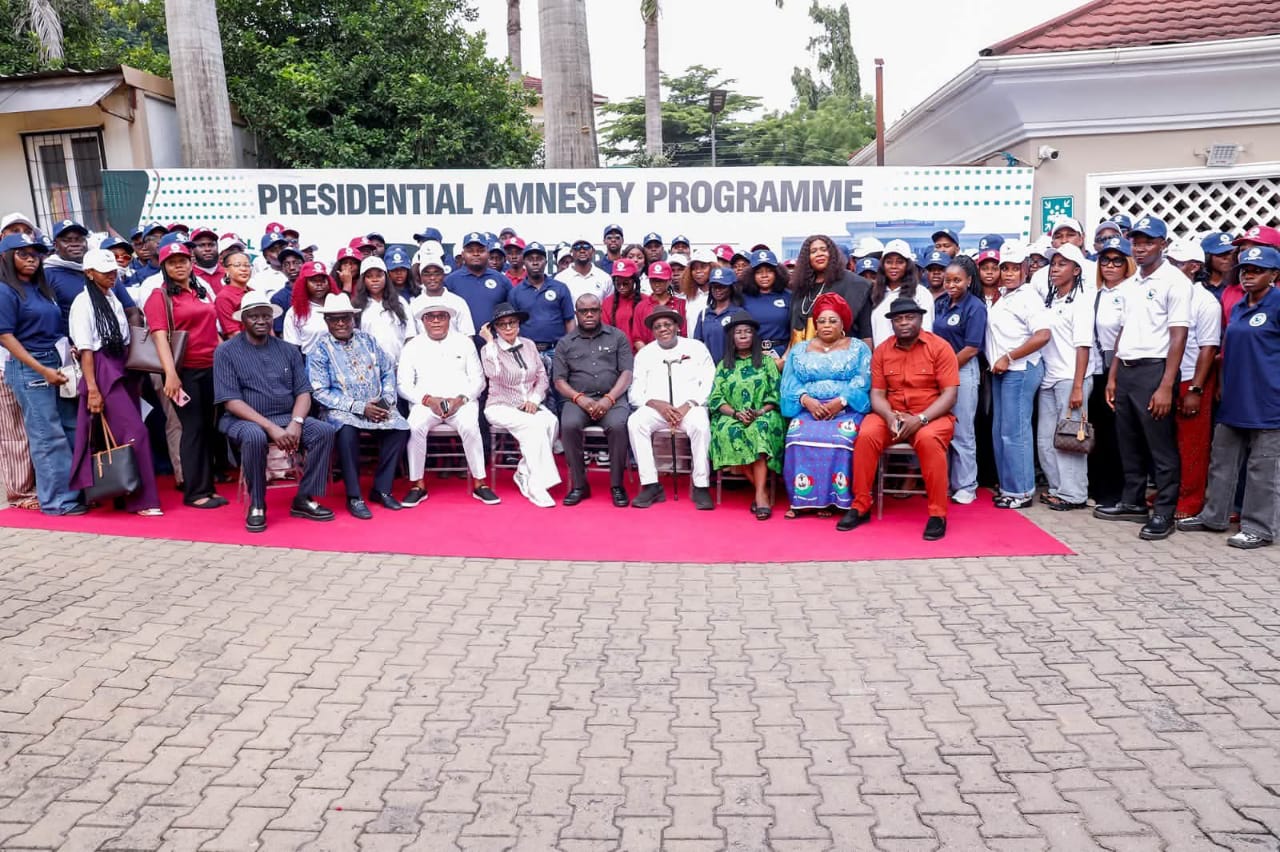
When 150 young men and women from the Niger Delta recently gathered at the headquarters of the Presidential Amnesty Programme (PAP) in Abuja for their pre-departure orientation, the moment represented more than another batch of scholarship beneficiaries preparing to travel abroad.
For a region once defined in global headlines by militancy, pipeline vandalism, kidnappings and attacks on oil installations, the departure of the beneficiaries for postgraduate studies in the United Kingdom tells a different story: one of an ongoing effort to replace the gun with education and turn restiveness into human capital.
The beneficiaries are expected to study specialised courses, including cyber security, software engineering, data science and analytics, law, forensic audit, fintech analytics, construction engineering management, global public health, and oil and gas engineering.
Their deployment also brings to 243 the number of beneficiaries sent abroad by the PAP this year, following the dispatch of 93 others in January and May.
But behind the figures is the broader story of the Niger Delta and the Presidential Amnesty Programme — an intervention born out of one of the most turbulent periods in the region’s recent history.
The Roots of Niger Delta Militancy
For decades, the Niger Delta has been the heart of Nigeria’s oil and gas industry. The region produces much of the crude oil that has historically sustained the country’s economy and provided a major source of government revenue.
Yet, despite its enormous contribution to the national economy, many communities in the oil-producing region have continued to grapple with poverty, unemployment, environmental degradation, poor infrastructure and a deep sense of exclusion from the wealth generated from their land and waterways.

These grievances, among other factors, contributed to growing youth restiveness in the region.
By the late 1990s and especially in the 2000s, armed groups emerged across parts of the Niger Delta, demanding greater control of resources, environmental justice and improved development for oil-producing communities.
The crisis escalated as militants attacked oil installations, sabotaged pipelines and engaged security forces. Kidnapping and other criminal activities also became widespread in some areas.
The consequences were enormous.
Oil production was severely disrupted at different periods, costing the country billions of dollars in lost revenue.
Oil companies shut down or reduced operations in affected locations, while insecurity created fear among residents and investors.
The crisis also claimed lives and further complicated the development challenges of the region.
It was against this backdrop that the Federal Government introduced the Presidential Amnesty Programme in 2009.
The initiative was designed as a pathway away from armed conflict by encouraging militants to lay down their weapons in exchange for amnesty and opportunities for rehabilitation, training and reintegration.
Thousands of former agitators accepted the offer, surrendered weapons and entered a structured process aimed at helping them acquire education, vocational skills and other capacities that could enable them to build productive lives.
While challenges have remained over the years, the programme has become one of the major peace-building interventions in the Niger Delta.
From the Creeks to the Classroom
Today, the emphasis of the programme has increasingly shifted towards education and human capital development.
For the Administrator of the Presidential Amnesty Programme, Dr Dennis Brutu Otuaro, the latest deployment of 150 postgraduate scholarship beneficiaries is part of a deliberate investment in the future of the Niger Delta.
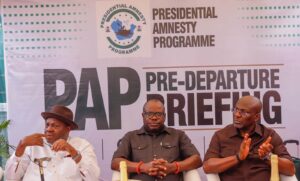
Speaking at the pre-departure orientation in Abuja, Otuaro said the beneficiaries represented some of the brightest and most vibrant youths of the region and urged them to take their studies seriously.
He said the scholarship programme was designed not only to provide individual beneficiaries with academic opportunities but also to build a human resource base capable of contributing to the development of Niger Delta communities and Nigeria as a whole.
According to him, sustained investment in education is also critical to the continued peace and stability of the region.
“This exercise underscores our commitment to ensuring that the Niger Delta youths have greater access to higher education within and outside Nigeria as we build a solid foundation for the region’s future,” Otuaro said.
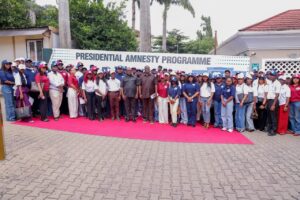
The PAP boss explained that 93 beneficiaries had already been deployed for offshore postgraduate programmes earlier in the year, while the latest batch of 150 would take the total number of foreign deployments in 2026 to 243.
Before the recent deployments, about 270 beneficiaries were already studying various courses in universities in the United Kingdom.
The courses reflect the changing demands of the global economy and the growing importance of technology and specialised knowledge.
Rather than concentrating only on traditional academic disciplines, the beneficiaries are being trained in areas such as cyber security, data science, software engineering, forensic audit, fintech and public health — skills that could position them for opportunities in a rapidly changing world.
A Growing Investment in Education:
Otuaro said the scale of educational support under the programme had continued to expand.
He disclosed that about 8,700 beneficiaries were currently pursuing programmes in institutions within Nigeria, while hundreds had also benefited from offshore education.
According to the PAP, 270 beneficiaries have been deployed to offshore universities, comprising 11 undergraduate students, 238 master’s degree students and 21 PhD candidates.
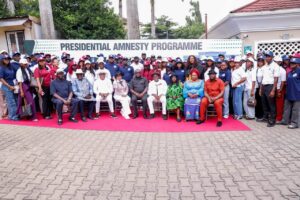
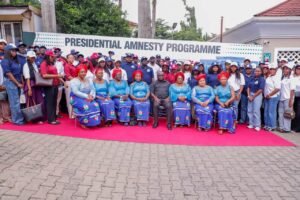
Of that number, 57 have graduated, many with distinctions, while others remain in training.
The programme has also recorded master’s and doctoral graduates from universities within Nigeria.
For the 2024/2025 academic session, the PAP recorded more than 50 first-class graduates and more than 134 graduates with second-class upper division.
For a programme that emerged from the ashes of armed conflict, such academic achievements carry symbolic significance.
They represent an attempt to redefine the future of young people from a region where many youths once saw agitation and militancy as the only way to draw attention to their communities.
The objective now is to ensure that more young people can become engineers, technology experts, researchers, lawyers, health professionals and entrepreneurs.
Otuaro Links Peace to Tinubu’s Support:
At the orientation, Otuaro attributed the expansion of the scholarship scheme and other interventions to the support of President Bola Tinubu.
He said the President’s backing for the programme under the Renewed Hope Agenda had made the large-scale educational deployments possible.
Otuaro also commended the National Security Adviser, Mallam Nuhu Ribadu, for his supervision and professional input into the programme.
Beyond the educational intervention, the PAP Administrator linked the prevailing peace in the Niger Delta to continued government engagement and investment in the region.
He urged the people of the Niger Delta to reciprocate what he described as President Tinubu’s developmental efforts by voting massively for him in the 2027 general elections.
According to Otuaro, sustained peace in the Niger Delta cannot be separated from sustained investment in the people, particularly the youth population.
His position reflects one of the central lessons of the Niger Delta crisis: military action alone cannot permanently resolve grievances rooted in unemployment, underdevelopment and exclusion.
Lasting peace, stakeholders have often argued, must be supported by economic opportunities, education, skills development and a genuine sense that communities and young people have a stake in the future.
The Bigger Challenge of Sustaining Peace:
Although the Niger Delta is far more peaceful today than it was at the height of militancy, the underlying development challenges that contributed to restiveness have not completely disappeared.
Youth unemployment remains a major concern. Many rural communities still lack basic infrastructure, while environmental pollution associated with years of oil exploration continues to affect livelihoods in some areas.
For this reason, the success of the Presidential Amnesty Programme cannot be measured only by the number of former agitators who surrendered weapons or the number of beneficiaries sent to schools.
Its long-term impact will also depend on what happens when beneficiaries complete their studies and return home.
Can their skills be integrated into the economy?
Will there be opportunities for them to contribute meaningfully to the development of their communities?
Can the human capital being developed translate into new businesses, technology solutions, stronger institutions and better economic opportunities for other young people?
These questions are critical to the future of the programme.
Otuaro has repeatedly emphasised that beneficiaries are expected to return after their studies and contribute to their communities and national development.
He urged the latest batch to see themselves as ambassadors of Nigeria and the Niger Delta, obey the laws of the United Kingdom and the regulations of their respective universities.
For the beneficiaries themselves, the scholarship offers an opportunity to acquire knowledge that could transform not only their individual lives but also the communities they come from.
Voices of Gratitude and Hope:
Two beneficiaries, Opukeme Gideon, who is studying for a Master’s degree in Cyber Security at the University of Aberdeen, and Afiyagba Peredisabofa, who is pursuing a Master’s degree in Oil and Gas at Coventry University, spoke on behalf of the beneficiaries.
They expressed gratitude to President Tinubu and Otuaro for the opportunity and pledged to work hard and make Nigeria and the Niger Delta proud.
Stakeholders from across the region also used the occasion to commend the Federal Government for sustaining the programme.
Among them were the Chairman of the Pan Niger Delta Forum, Dr Boladei Igali; Prof. Ben Binebai of the Niger Delta University; Niger Delta activist, Annkio Briggs; Senior Policy Adviser to the Delta State Governor, Hon. Funkekeme Solomon; and the President of the Ijaw Youth Council, Dr Doubra Okotete.
They described the expansion of the scholarship scheme as an investment capable of impacting generations.
The stakeholders also commended Otuaro for paying attention to gender inclusion in the selection process, noting that the female-to-male ratio among the latest beneficiaries was encouraging.
At the orientation, the beneficiaries received guidance on social and cultural dynamics, academic expectations, security while studying abroad and financial prudence.
For young people travelling thousands of kilometres away from home, such orientation is considered important, particularly as many will be adapting to a new educational system, culture and environment.
A Legacy Beyond the Scholarship:
The sttory of the Presidential Amnesty Programme is ultimately intertwined with the story of the Niger Delta itself.
It is the story of a region that has known conflict but continues to search for sustainable peace.
It is the story of young people who once carried the burden of frustration and restiveness but are increasingly being given opportunities to acquire knowledge and skills.
The dispatch of another 150 beneficiaries to universities in the United Kingdom may therefore be seen as more than a scholarship exercise.
It is part of a wider attempt to demonstrate that investment in people can become an instrument of peace.
From the creeks where militancy once threatened Nigeria’s economic stability to classrooms and research centres in Nigeria and abroad, the transformation is significant.
But the ultimate test will be whether the education, skills and exposure acquired by the beneficiaries will return to enrich the Niger Delta.
If the programme succeeds in producing a generation of professionals, innovators and leaders who can create opportunities and help address the development challenges of their communities, the investment will have achieved something far greater than the award of certificates.
It will have helped to build a bridge between the troubled past of the Niger Delta and the possibility of a more peaceful, prosperous and knowledge-driven future.
And for a region whose history has been shaped by the struggle for development and inclusion, that may be one of the most important investments of all.
