


Jeki VI and the Enduring Legacy of Opobo’s Royal Dynast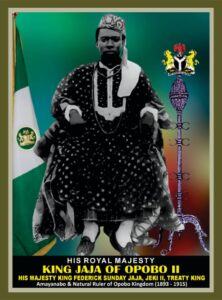
By Crystalnews Admin
As Opobo Kingdom prepares to coronate its sixth monarch, His Majesty King Charles Douglas MacPepple Jaja, the historical significance of the ancient Niger Delta kingdom is once again coming into sharp focus.
The coronation, scheduled for September 18 to 27, 2026, is not merely a traditional ceremony.
It is a moment of succession, remembrance and renewal—an occasion that connects the incoming monarch to a royal lineage whose history is inseparable from the struggle for self-determination, the defence of indigenous enterprise and the preservation of the cultural identity of the Opobo people.
At the centre of that history is the legendary King Jaja of Opobo, whose resistance to British colonial domination established a legacy that continues to influence the kingdom’s understanding of leadership and responsibility.
King Jaja’s opposition to British interference in the palm produce trade was rooted in his determination to protect the economic interests of his people.
He resisted attempts to deprive indigenous traders of their role in the commercial system and opposed colonial policies that threatened Opobo’s economic independence.
His resistance was not a rejection of progress. Rather, he recognised the importance of education, enterprise and intellectual development in preparing his people for a changing world.
His legacy therefore combines economic self-reliance, political courage, cultural pride and the conviction that a people must have a voice in determining their own future.
It is this inheritance that King Charles Douglas MacPepple Jaja, the Amanyanabo-elect of Opobo Kingdom, is expected to uphold and advance when he ascends the throne as Jeki VI.
A Crown of Responsibility:
Shortly after his election on December 31, 2025, the Amanyanabo-elect was presented to the Alapu and people of Opobo Kingdom on January 3, 2026.
During the presentation, he acknowledged the weight of the crown he was preparing to wear and pledged to uphold the sacred trust of tradition, ancestry and the collective will of the people.
“Our heritage is our strength,” he declared, outlining a vision that seeks to combine development with cultural preservation, skills acquisition, youth empowerment and the active promotion of the Ibani language.
That vision reflects the changing responsibilities of traditional rulers in contemporary Nigeria.
Beyond their ceremonial roles, monarchs are increasingly expected to serve as custodians of identity, promoters of peace, advocates of development and bridges between their communities and government.
For Opobo, where history, culture and commerce have long been closely intertwined, the challenge before Jeki VI will be to preserve the kingdom’s distinctive heritage while ensuring that its people are equipped to participate fully in the modern economy.
Royal Tutelage and Preparation:
The incoming monarch’s preparation for the throne has been shaped by both education and royal tutelage.
He was educated at Government Technical College, Abak, in present-day Akwa Ibom State, and later obtained a degree in Political Science and Administration from the University of Port Harcourt, alongside other credentials and certifications from various institutions.
Before his election, he was actively involved in several socio-cultural organisations, including the Mina Ogbo Ikina Cultural Society and the Ugele Mkpa Nwaotam Society, both of Opobo Town.
He also served as head of the ruling MacPepple War Canoe House from January 2010 until his election to the throne.
His involvement in the Owu-Ogbo Cultural Society, the custodian of the cultural and customary traditions of the kingdom, further reflects his longstanding connection with the institutions that preserve Opobo’s identity.
These experiences have placed him in a position to understand the expectations of the people and the responsibilities associated with the Amanyanabo stool.
His royal tutelage was also steeped in service, responsibility and history under his father, the late King Douglas MacPepple Jaja.
That relationship provided the incoming monarch with an opportunity to observe leadership not merely as a position of honour, but as a duty to the people and the generations yet unborn.
The Immediate Legacy of Jeki V
The reign of King Charles Jaja will follow that of his elder brother and immediate predecessor, King (Dr.) Dandeson Douglas Jaja, CFR, DSSRS, JP, Jeki V, Treaty King, Natural Ruler and Amanyanabo of Opobo Kingdom.
King Dandeson Jaja ascended the throne on January 3, 2004, after a 23-year legal and succession struggle.
His emergence brought an end to a prolonged period of uncertainty over the traditional rulership of the kingdom.
His ascension was widely regarded as a restoration of order and continuity to the Opobo throne. It also attracted recognition from the government and people of Rivers State for the kingdom’s commitment to peace and lawful resolution of disputes.
As monarch, Jeki V was passionate about preserving peace within his domain and promoting Opobo’s cultural heritage.
He championed the Opobo International Boat Carnival, an initiative that sought to promote cultural tourism and create economic opportunities for the people of the kingdom and Rivers State.
He was equally committed to the pursuit of reparation for the unjust kidnap, trial, exile and suspected killing of King Jaja by the British colonial government.
That campaign represented a determination to ensure that the historical experience of Opobo would not be forgotten or reduced to a footnote in colonial history.
His leadership extended beyond Opobo. He was elected co-chairman of the Southern Nigeria Council of Traditional Rulers, a position he held until his death, and served as chairman of the Rivers State Council of Traditional Rulers from 2015 to 2023.
In 2017, he was conferred with the national honour of Commander of the Order of the Federal Republic (CFR) by President Muhammadu Buhari.
Through these roles, Jeki V brought national and international visibility to Opobo Kingdom and demonstrated the capacity of traditional institutions to contribute to wider discussions on peace, development and regional interests.
He was variously described as a statesman, pragmatic ruler, compassionate leader and an embodiment of wisdom, fairness and dedication to cultural preservation.
A Christian of deep faith, he was also known for dedicating his birthdays to praise and worship, reflecting the spiritual convictions that shaped his personal life and leadership.
King Douglas MacPepple Jaja: A Reign of Peace:
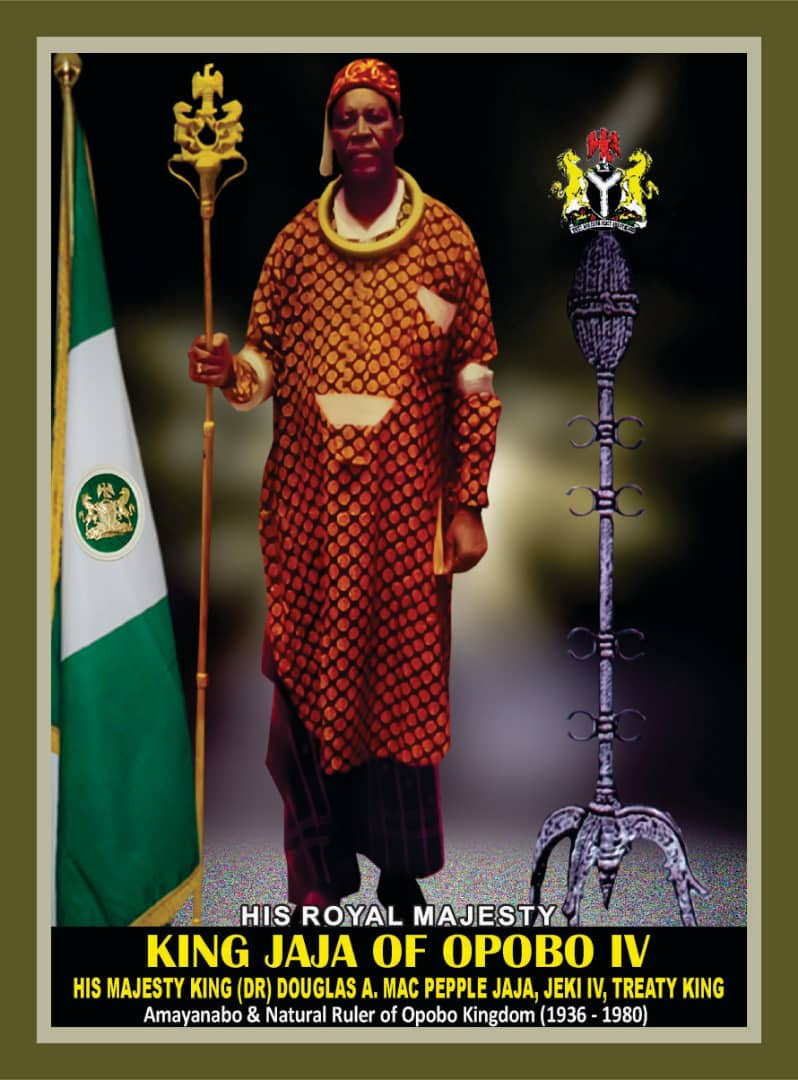
Before Jeki V was his father, King Douglas MacPepple Jaja, who reigned from 1936 to 1980.
A charismatic leader and man of the people, King Douglas Jaja sustained the vision of the founding king and protected the cultural heritage of the kingdom.
He was a patron of the Nwaotam Cultural Carnival and a committed sponsor of the Owu-Ogbo, the institution responsible for preserving the cultural and customary traditions of Opobo.
His reign was marked by peace, stability and respect for the kingdom. He was appointed a member of the Eastern Nigerian Traditional Rulers Council and later served as Chancellor of the University of Jos.
His peaceful reign was interrupted only by his death, which was followed by the prolonged succession dispute that eventually led to the emergence of his son, King Dandeson Jaja.
The continuity between father and son is significant. Both were deeply connected to the cultural life of Opobo and committed to the preservation of the kingdom’s traditions.
Their reigns demonstrated that the strength of a monarchy is not measured only by the length of its tenure, but also by the stability, dignity and sense of identity it leaves behind.
King Arthur MacPepple Jaja: Education and Diplomacy
King Douglas Jaja was preceded by his father, King Hon. Arthur MacPepple Jaja, Jeki III. Educated in Scotland for 11 years, King Arthur was among the early successors of the founding King Jaja. At the age of 21, he established the MacPepple War Canoe House in 1893.
His reign was devoted largely to consolidating peace, security and progress in the aftermath of the exile and death of the founding monarch.
Unlike the difficult relationship between the British colonial authorities and King Jaja, King Arthur’s royal breeding, education and diplomatic disposition helped to establish a more constructive relationship with the colonial administration.
He became the first paramount ruler of Opobo Kingdom to receive recognition from the British government, which had previously been hostile to his elder brother and predecessor, King Frederick Sunday Jaja.
He also became the first Opobo ruler to serve in the Nigerian Legislative Council in Lagos.
His reign coincided with the Aba Women’s Riot of 1929, a period of widespread colonial unrest in the Eastern Region.
He is reputed to have ensured that casualties in Opobo Kingdom were kept to a minimum, maintaining peace and stability until his death in 1936.
King Frederick Sunday Jaja: Preserving the Throne
King Arthur’s predecessor was Prince Frederick Sunday Jaja, Jeki II, who ruled from 1893 to 1915.
Despite the apprehension and opposition of the British colonial government, which feared that he might follow the example of the founding King Jaja, Frederick Sunday Jaja was accepted by his people as the successor to the throne.
The colonial authorities’ reluctance to recognise him reflected their continuing unease with the memory of King Jaja’s resistance. Yet the people of Opobo preserved his place in their history.
King Frederick Sunday Jaja is remembered as an advocate of peace and a preserver of the socio-cultural and moral fabric of the kingdom.
He is particularly credited with revitalising the Owu-Ogbo, the institution that serves as the custodian of Opobo’s cultural traditions.
His reign demonstrated that the preservation of a kingdom’s identity could be as important as the defence of its political interests.
The Road Ahead for Jeki VI
With the coronation of King Charles Douglas MacPepple Jaja approaching, Opobo Kingdom stands at another important point in its history.
The incoming monarch inherits a throne shaped by resistance, diplomacy, education, cultural preservation and the pursuit of justice.
He also inherits the expectations of a people who have seen their kingdom navigate colonial domination, succession disputes, changing political structures and the demands of modern development.
One of the major expectations is that he will sustain the unfinished struggle for reparation for the inhuman treatment of King Jaja by the British colonial government.
That responsibility is not simply about the past. It is also about ensuring that the history of Opobo is properly understood and that the sacrifices of its founding generation continue to inform the future of the kingdom.
Jeki VI will also be expected to blend traditional authority with intellect, refinement and enlightened leadership.
In an era when communities face economic pressures, youth unemployment, cultural erosion and the challenges of modern governance, the role of a monarch extends beyond the preservation of customs.
The king must be able to inspire confidence, promote peace, encourage education and skills development, and create opportunities for the younger generation.
For Opobo, the promotion of the Ibani language, the strengthening of cultural institutions and the development of tourism can serve as important pillars of this new reign.
The Opobo International Boat Carnival, the Nwaotam Cultural Carnival and the Owu-Ogbo institution remain valuable examples of how culture can be transformed into a source of unity, identity and economic opportunity.
The incoming monarch’s stated commitment to these areas therefore offers a basis for optimism.
A Legacy to Sustain
The history of Opobo’s monarchy is a history of continuity through change.
From the founding King Jaja’s resistance to colonial domination, through the diplomatic leadership of King Arthur MacPepple Jaja, the cultural stewardship of King Frederick Sunday Jaja, the peaceful reign of King Douglas MacPepple Jaja and the national visibility achieved under Jeki V, the throne has remained a symbol of the kingdom’s identity and collective aspirations.
King Charles Douglas MacPepple Jaja now stands at the threshold of that inheritance.
His coronation will mark the beginning of a new chapter, but the responsibility before him is clear: to preserve the dignity of the throne, strengthen the unity of the people and translate the legacies of his predecessors into meaningful progress.
If he succeeds in combining the wisdom of tradition with the demands of contemporary leadership, Jeki VI could help position Opobo Kingdom for a new era of cultural confidence, economic opportunity and national relevance.
The crown he is about to wear is therefore more than a symbol of authority. It is a sacred trust—a responsibility to the ancestors, to the present generation and to the future of Opobo Kingdom.
