


VREI Challenges Itu Officials: ‘Do Not Certify What You Have Not Verified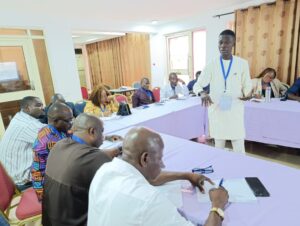
By Peace Osigwe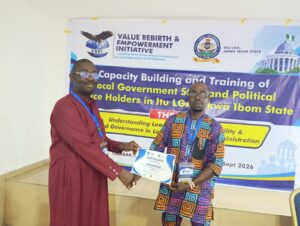

For residents of local government areas, good governance is rarely measured by speeches or policy documents.
It is seen in the quality of roads, functioning projects, responsible use of public funds and the speed with which officials respond to their needs.
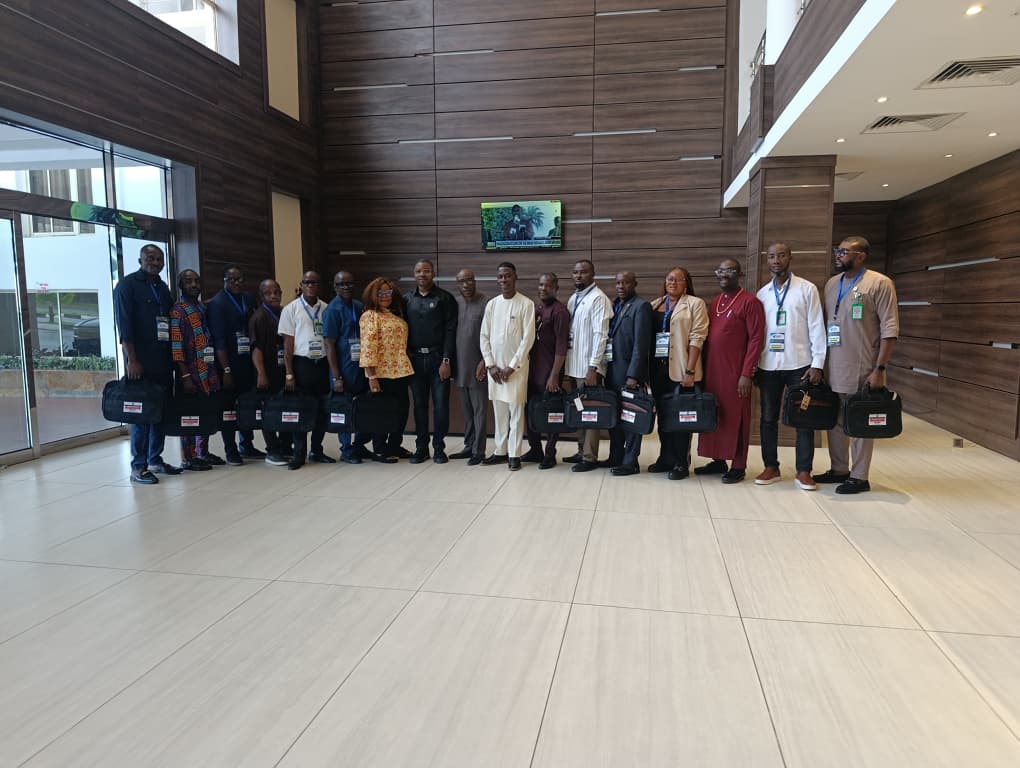
It was against this background that the Value Rebirth and Empowerment Initiative (VREI), in collaboration with Itu Local Government Area of Akwa Ibom State, brought political office holders and council staff together for a one-day training on leadership, accountability and good governance.
The programme, held on Monday at Monty Hotels & Suites, Calabar, Cross River State, challenged participants to look beyond occupying public offices and focus more on the responsibilities that come with serving the people.
With the theme, “Understanding Leadership, Accountability & Good Governance in Local Government Administration,” the training addressed some of the everyday issues that can determine whether government works effectively at the grassroots.
One of the strongest messages from the programme came from facilitator, Mr. Obot Obot, who urged officials to verify projects, contracts, reports and public expenditure before certifying or approving them.
His message was simple: “Do not certify what you have not verified.”
The statement struck at one of the most important responsibilities of public officials—ensuring that what exists on paper also exists in reality.
For communities, the difference can be significant. A project that is properly inspected before payment or certification is more likely to meet the required standard, while proper scrutiny of public expenditure can help protect resources meant for development.
Obot also encouraged officials to examine the habits that have developed within their workplaces, noting that repeated behaviours could eventually become institutional culture.
He urged participants to replace practices that slow down government business with habits that promote teamwork, accountability, effective communication and problem-solving.
Leadership Beyond Occupying Office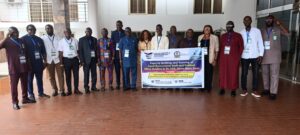
Earlier, Pst. Edewor Egedegbe, who delivered the first lecture, reminded the participants that leadership was not simply about holding a title.
According to him, leadership comes with the responsibility to make sound decisions, communicate effectively and turn plans into results that citizens can see.
He encouraged the officials to approach their responsibilities with integrity and a stronger sense of duty, stressing that effective leadership should ultimately translate into improved outcomes for the people.
Where Will the Money Come From?
Another question raised during the training was how local governments could achieve meaningful development when resources are limited.
Prof. Andrew Agboro, who spoke on resource mobilisation, encouraged Itu officials not to depend solely on government allocations.
He urged them to identify opportunities within the local economy and explore legitimate partnerships, grants, private-sector investment, agriculture, agro-processing, tourism, youth empowerment and skills development.
Agboro advised the council to first identify the resources available within its communities, map potential partners and develop credible proposals capable of attracting funding and technical support.
The idea, he explained, is to make available resources work harder for the people.
Chairman: Training Is Timely
The Executive Chairman of Itu Local Government Area, Hon. Ubong Nkutt, commended VREI for organising the programme.
Nkutt said the training was relevant to both political office holders and career officials because they are directly responsible for implementing government policies and managing the affairs of the council.
He said the lessons were also consistent with the development objectives of the Akwa Ibom State Government under Governor Umo Eno’s ARISE Agenda.
The chairman expressed appreciation to VREI for providing an opportunity for the council officials to reflect on their responsibilities and learn practical approaches to improving administration.
From Training Room to Communities
The real test, however, begins after the certificates have been collected.
Participants were asked to identify things they should stop, start and continue doing in their various offices.
The exercise was designed to move the discussion away from theory and towards practical changes in the way officials work.
They were also encouraged to strengthen collaboration between political office holders and career officials, improve communication, engage citizens and ensure that government activities produce measurable results.
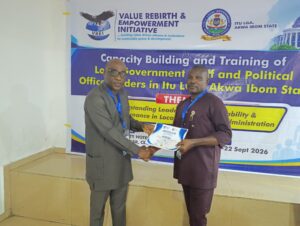
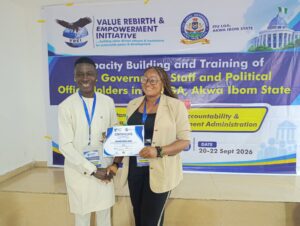
At the end of the programme, certificates were presented to participants.
For VREI, the objective goes beyond organising another training programme.
The organisation said it wants capacity development to contribute to stronger institutions, responsible leadership and better management of public resources.
And for the people at the grassroots, the expectation is straightforward: that lessons learnt in a training room will eventually be reflected in the decisions officials make, the projects they supervise, the resources they manage and, ultimately, the quality of services delivered to their communities.
