


2027: Opposition Coalition Too Late to Stop Tinubu, Says Plan
Peace Osigwe
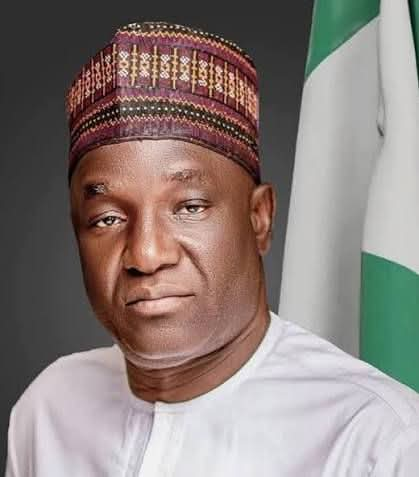
Senator representing Plateau Central, Diket Plang, has described the opposition coalition seeking to unseat President Bola Ahmed Tinubu in the 2027 general elections as a belated move, arguing that a stronger alliance should have been formed before political parties conducted their primaries and selected candidates.
Plang, who expressed confidence that the All Progressives Congress (APC) would secure victory in the majority of elective positions in Plateau State in 2027, also declared his support for Tinubu’s re-election bid.
Speaking with journalists in Jos, the senator predicted that the APC would perform strongly in the governorship, National Assembly and State House of Assembly elections in the state.
“I am deeply convinced that APC will win the majority of the seats, whether in the governorship election, the National Assembly election, or the State House of Assembly election,” he said.
On the opposition coalition, Plang argued that its late emergence had weakened its potential to challenge the ruling party, noting that the participating parties had already selected their candidates before the alliance took shape.
“They came very late. A genuine coalition should have been formed before the parties produced their candidates,” he said, describing the arrangement as “more of a merger of convenience than a holistic coalition.”
The lawmaker also defended Tinubu’s campaign strategy, arguing that a presidential candidate did not necessarily have to visit every community or polling unit to communicate effectively with voters.
Questioning the practicality of extensive campaign tours, Plang asked whether a candidate was expected to visit every state, local government, ward or polling unit across the country.
“Anybody who claims the capacity to go round the country should tell us whether he will visit every polling unit. I am waiting to see a presidential candidate who will go round all the polling units,” he said.
According to him, a well-coordinated campaign structure could effectively communicate a candidate’s programmes and manifesto to Nigerians across the country.
He explained that campaign messages could be transmitted from the national level to geopolitical zones, states, local governments and wards before reaching individual voters.
“If you have a campaign team that can take your message to the people, explain your manifesto and tell them what you intend to do, that is also a way of reaching the electorate,” he said.
On insecurity, Plang described the challenge as a major concern for Nigerians and identified the expansion of security formations and improved welfare for personnel as important measures for addressing the problem.
He commended the establishment of additional military formations, particularly in Plateau State, arguing that the presence of more troops could strengthen efforts to protect lives and property.
“At a time like this, you all know that what is foremost in the minds of Nigerians is security. If you find a president who is willing to expand the security forces, improve their salaries reasonably and establish more military formations, including companies, battalions and divisions, you have to consider what that means for the country,” he said.
Specifically, the senator cited additional military battalions in Mangu, Barkin Ladi and Wase, as well as another in Langtang, as developments he considered significant to security in Plateau State.
He said the establishment of permanent military bases in Mangu and Barkin Ladi would further strengthen efforts to tackle insecurity in the affected areas.
“If you wake up tomorrow and find that the President is willing to establish permanent military bases in Mangu and Barkin Ladi, it gives hope that something is being done to address insecurity,” he said.
Plang maintained that the Federal Government had demonstrated a commitment to addressing security challenges through the expansion of military formations and improved attention to the welfare of security personnel.
“There is an intentional decision by this President to give priority to security and address the high level of insecurity in the country,” he said.
He urged Nigerians to give Tinubu another opportunity to consolidate his administration’s efforts and reforms, particularly in the security sector.
“For me, we need to give him another opportunity to concentrate on the reforms and efforts he has started in tackling insecurity,” he added.
On infrastructure, Plang, a member of the Senate Committee on Works, praised the Federal Government’s ongoing road projects, saying his position had provided him with opportunities to inspect major infrastructure developments across the country.
He cited the Lagos-Calabar Coastal Highway as an example of a project whose scale initially appeared difficult to achieve.
According to him, his initial doubts about the project changed after he witnessed its progress and attended the commissioning of its first phase.
“Honestly, when we went for the flag-off, I saw what looked like an impossibility. When they talked about reclaiming parts of the ocean and constructing drainages around the lagoons to create the road, I thought it was a dream,” he said.
He added: “But I later had the opportunity to attend the commissioning of the first phase of the road. I have seen the project practically, and I can tell you that the reality is different from what many people imagined.”
The senator also cited work on the Akwanga-Keffi road corridor, describing the administration’s infrastructure programme as a long-term investment capable of supporting economic growth and development.
“If you look at the infrastructure projects the President has embarked upon, you will see that they are futuristic and offer hope for economic development,” he said.
Plang argued that Nigerians should consider the progress recorded in infrastructure and security when assessing the administration’s performance ahead of the 2027 elections.
“If you have somebody with the courage and determination to undertake such projects, I do not think it is wise to gamble with another trial when we have already seen the direction we are going,” he said.
He urged voters to evaluate political leaders based on their records and achievements rather than abandon ongoing reforms for an alternative whose performance, he argued, remained uncertain.
