


Otuogori Bridge Accident: Beyond the Viral Vide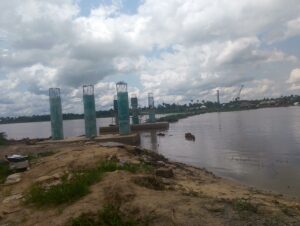
By Peace Osigwe
Background:
For a region where rivers, creeks and difficult terrain have continued to shape the everyday experiences of residents, the construction of bridges and roads is not merely about concrete, steel and engineering calculations. It is about connecting people to opportunities, enabling traders to move their goods, making access to healthcare easier and giving communities a stronger sense of inclusion in the development process.
It was against this background that news of an accident at the construction site of the 600-metre Otuogori Bridge generated considerable public concern.
A video showing several bridge beams falling against one another during construction circulated widely on social media, triggering claims that the bridge had collapsed.
The images were alarming. For many who watched the video without understanding the technical circumstances surrounding the incident, the impression was that an important development project had suffered a major structural failure.
Some social media accounts also suggested that the falling beams had plunged into the river, with rumours that people travelling on the water might have been trapped or drowned.
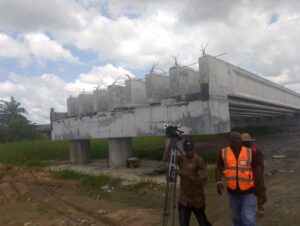
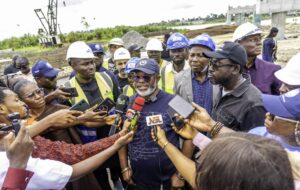
But when officials of the Niger Delta Development Commission (NDDC), journalists and representatives of the construction company visited the site for an on-the-spot assessment, a different account emerged.
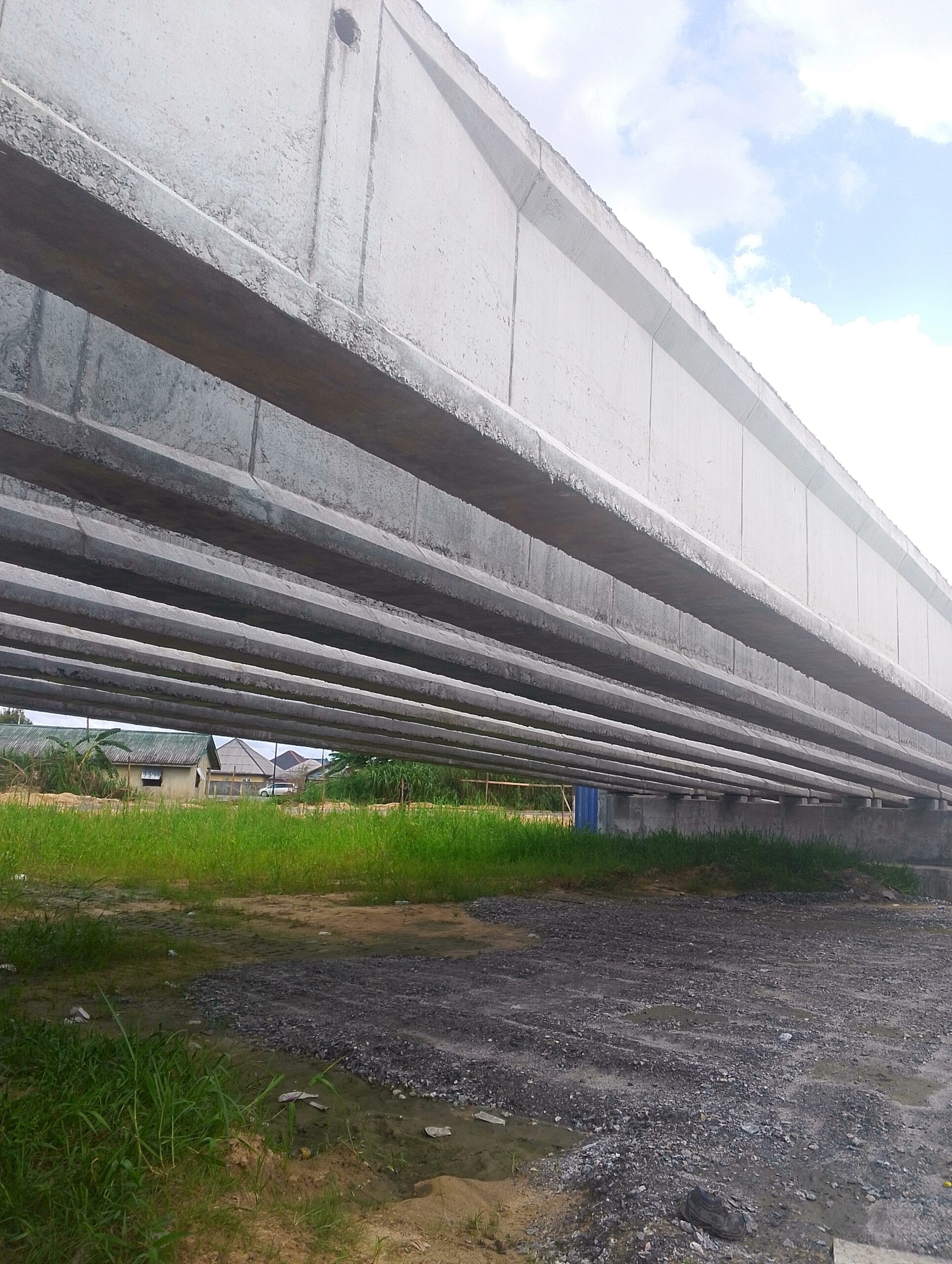
The engineers explained that the incident occurred during the positioning of prestressed concrete beams, when a lifting belt snapped, causing one beam to slide and strike others.
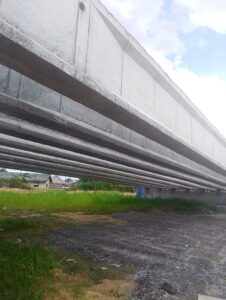
Although the accident damaged several beams and left one construction worker injured, the engineers maintained that the bridge’s supporting structure remained intact.
Behind the viral images, therefore, was a construction accident that raised questions about safety, engineering procedures and public communication, but also brought into focus the importance of the project to the communities waiting for its completion.
The Morning the Beams Came Down
For the construction workers, the day began like other working days at the project site.
The team was engaged in the launching and positioning of the concrete beams that would eventually form part of the bridge’s superstructure.
The process involved the use of a crane to lift and position the heavy prestressed beams between the bridge’s supporting piers.
According to Engineer Abdul Eric, who represents Jillian Group of Companies and oversees the piling section of the project, the incident happened after workers encountered difficulties positioning one of the beams.
He explained that the sixth beam was not properly seated, prompting him to direct the team to reposition it.
After the repositioning exercise, the crane was being lowered to allow workers to remove its supporting bed when the belt snapped.
The sudden failure caused the beam to slide and fall against other beams, resulting in further damage.
Eric explained that the swinging movement of the crane’s bed also caused another beam to be struck, leaving a worker injured.
He said:
“After we finished positioning it, the crane was being lowered so that we could remove the bed from the supporting structure. In the process of lowering the bed, the belt cut, and the beam slid and fell on the other beams.”
For the workers, it was an unexpected incident in the middle of a delicate construction operation.
Eric confirmed that one of the workers sustained injuries and was receiving medical attention.
He, however, described the worker’s condition as stable, saying he could walk, talk and move.
According to him, the medical team would determine when the worker would be fit to return to the construction site.
There were no reported fatalities.
The engineer also dismissed claims that the beams had fallen into the river or that people travelling on the water had drowned.
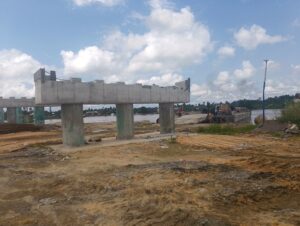
He explained that the affected section was about 100 metres from the river, while the beams were approximately 25 metres long.
“There is nothing like a bridge falling on persons in the river. From here to the river is about 100 metres away from us. How will the bridge fall into the river?” he asked.
What Actually Happened? Engineers Explain the Technical Details
While the viral video captured the falling beams, it did not explain the technical stage of construction at which the incident occurred.
This distinction became central to the explanations provided by the engineers during the inspection.
Engineer Dr. Righteous Gilbert Damina, the company’s structural engineer and Community Liaison Officer, explained that the bridge was being constructed in stages.
According to him, work had progressed from the abutment to Pier One and Pier Two, while the incident occurred during the positioning of beams between Pier Two and Pier Three.
He explained that the construction process required the beams to be properly positioned before other structural components, including concrete slabs, reinforcement and transverse beams, could be installed.
These additional components would contribute to the stability and overall structural performance of the completed bridge.
Damina said the accident affected the beams but did not compromise the underlying supporting structure.
“Basically, the structure is intact. The main things that were damaged were the beams. There is no other thing that has been damaged on this bridge,” he said.
He explained that the beams were prestressed concrete members designed to perform under particular loading conditions.
Consequently, the damaged beams would not be repaired and reused.
Instead, the company had decided to discard them and replace them with new ones.
According to Damina, more than 100 replacement beams were already available at the project site, eliminating the need to begin another casting process before work could continue.
He said the company was making arrangements to reposition the bearings and resume the launching of replacement beams.
He expressed optimism that the exercise would commence within the week.
His explanation was intended to reassure the public that the incident had not destroyed the bridge’s foundation or supporting piers.
However, the accident also demonstrated how a failure involving one piece of lifting equipment could affect several heavy construction components and disrupt an ongoing engineering operation.
The Project Manager’s Account: A Belt Snapped During Installation
The project manager, Aysar Adnan Alzugayyar, also provided an account of the incident.
He explained that the project involved multiple spans, with each beam measuring approximately 25 metres.
According to him, the team had successfully positioned the first level of beams before proceeding to the next stage.
The accident happened while workers were positioning another beam and attempting to release the lifting arrangement.
He said the belt snapped from inside, causing the beam to fall and strike other beams.
Alzugayyar explained that the beams were designed to carry loads in their intended installed positions, and that the impact of falling against one another resulted in damage.
He confirmed that one member of the workforce sustained injuries and received treatment.
The project manager said the company was taking care of the affected worker.
His account reinforced the explanation that the incident occurred during the installation process rather than after completion of the bridge.
For a project involving heavy prestressed concrete members, the positioning process requires careful coordination between the crane operator, engineers and workers on the supporting structures.
The incident has therefore placed the spotlight on the importance of lifting equipment, proper positioning and safety procedures during construction.
The NDDC Steps In to Investigate
For the Niger Delta Development Commission, the incident required more than an explanation from the contractor.
As the agency responsible for the project, it had to establish what happened, assess the extent of the damage and determine the implications for the project’s delivery.
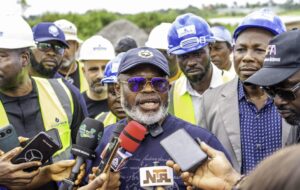
Speaking during the inspection, the NDDC State Director in Bayelsa, Engineer Godknows Alamieyeseigha, said the commission had commenced an on-the-spot assessment.
He dismissed suggestions that the incident represented a collapse of the bridge, describing it as an accident that occurred during construction.
Alamieyeseigha expressed confidence in Jillian Group of Companies’ ability to address the issues identified and continue with the project.
He also assured that the commission would make its findings public after the preliminary investigation.
His position was significant because the public had a legitimate interest in knowing whether the accident was caused by equipment failure, construction procedures or other factors.
Beyond reassuring residents, the investigation would help establish the circumstances surrounding the incident and identify any measures necessary to prevent a recurrence.
For the communities awaiting the bridge, the most important issue is not simply whether the structure remains standing, but whether the project can proceed safely and meet the required engineering standards.
The Man Behind the Viral Video: ‘I Did Not Mean to Misrepresent What Happened’
Perhaps one of the most interesting human-interest aspects of the incident was the appearance of Mike Apango, the man who recorded and circulated the video that generated widespread reactions.
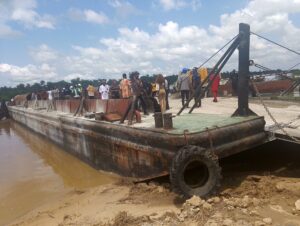
Apango, who identified himself as a teacher from Eleme Local Government Area of Rivers State, said he was on a barge near the construction site when the incident occurred at about 9am.
He explained that he lived and slept around the project location and was therefore close enough to witness the accident.
According to him, he saw the lifting belt snap while workers were positioning the beam.
He watched as the first beam fell against another, triggering a chain reaction that caused additional beams to come down.
He subsequently recorded and circulated the video.
However, Apango acknowledged that the description he used in presenting the incident created the impression that the entire bridge had collapsed.
During the inspection, he appealed to Nigerians and the NDDC to forgive him for the wording he used.
Speaking emotionally, he said:
“It was not intentional. The belt was cut; it was not that the bridge fell. When the belt got cut, the beam hit another one, and that one hit another. That was what caused the accident.”
He explained that he had not intended to misrepresent the situation or create unnecessary panic.
Apango said he recorded the incident because he was living around the construction site and believed it was important to draw attention to what had happened.
He also appealed to the public not to interpret his video as evidence that the bridge had collapsed into the river.
His appearance added another dimension to the story.
In an era when social media videos can reach thousands of people within minutes, the incident demonstrated how images without adequate technical explanation can generate conclusions that differ from what actually happened.
It also raised an important question about the responsibility of eyewitnesses and social media users to distinguish between what they observe and how they describe it.
Apango’s apology did not erase the public concern generated by the video, but his account helped clarify what he witnessed.
A Bridge That Means More Than Infrastructure
Beyond the accident and the competing descriptions of what happened, the Otuogori Bridge remains an important development project for Ogbia Local Government Area.
For communities separated by waterways and difficult terrain, infrastructure projects can determine how easily residents access markets, schools, hospitals and other essential services.
A completed bridge can reduce dependence on alternative transportation arrangements, improve the movement of agricultural produce and create opportunities for commercial activities.
It can also make it easier for residents to travel between neighbouring communities without the difficulties associated with water transportation.
For families, traders, students and other residents, the benefits are practical and immediate.
A trader who can move goods more easily has a better opportunity to reach customers.
A patient who can access healthcare more conveniently may have a better chance of receiving timely attention.
Students can also benefit from improved movement between communities.
These are the everyday expectations attached to the Otuogori Bridge.
However, those benefits remain expectations until the project is completed, inspected and opened for public use.
This is why the accident has attracted attention beyond the immediate construction site.
Residents do not simply want an explanation of why the beams fell. They want assurance that the bridge will be delivered safely and that the incident will not become another setback to their long-standing infrastructure needs.
Ogbuku’s NDDC and the Wider Development Agenda
The Otuogori Bridge is one of several infrastructure interventions being undertaken by the NDDC across the Niger Delta region.
Since its establishment more than two decades ago, the commission has been mandated to address the developmental challenges confronting the oil-producing communities of the region.
Its interventions cut across roads and bridges, electricity, water supply, education, healthcare, community development and other critical sectors.
Under the leadership of its Managing Director and Chief Executive Officer, Chief Samuel Ogbuku, the commission has continued to pursue its development agenda through projects spread across the nine states of the Niger Delta.
The commission’s vision is to offer lasting solutions to the socio-economic difficulties of the region.
Available entries in its project database show ongoing interventions in different communities, including Bayelsa State.
In the electricity sector, the commission has listed solar streetlight projects at Angalabiri in Sagbama Local Government Area, Isampou in Ekeremor Local Government Area and Adagbabiri/Aya Adagbabiri Road, also in Sagbama.
Other solar streetlight interventions are listed in communities across Akwa Ibom, Rivers, Imo, Delta and Ondo states.
In the water supply sector, the NDDC has listed a 10,000-gallon-capacity solar-powered water project at Odoni in Sagbama Local Government Area and another at Isampou in Ekeremor Local Government Area.
These projects are intended to improve access to potable water in communities where residents have historically faced difficulties obtaining reliable water supplies.
The commission’s project database also lists ongoing educational infrastructure interventions in Bayelsa.
Among them are the construction of dormitory blocks at the secondary/vocational school in Ayakoro, Ogbia Local Government Area, staff quarters for the school and the reconstruction of a six-classroom block at Trofani in Sagbama Local Government Area.
A town hall project at Otuogidi in Ogbia Local Government Area and a fence wall project for a secondary school at Ayama Ijaw in Southern Ijaw Local Government Area are also listed.
In the roads and bridges category, the NDDC has listed the emergency construction of the Sangatama radial road in Ogbia Local Government Area under different project lots.
These interventions reflect the range of development needs that the commission is expected to address across the region.
It is important, however, to distinguish between projects listed as ongoing and those that have been completed and handed over to their beneficiaries.
Beyond Roads: NDDC’s Intervention in Maritime Security
The commission’s interventions also extend beyond conventional infrastructure.
In another development, the NDDC handed over a number of operational facilities and equipment to the Nigerian Navy to strengthen its maritime operations.
The items included furnished accommodation blocks, a 40-person operational houseboat, a first gunboat and a second gunboat.
Other facilities handed over were solar inverter backup systems for administrative and accommodation blocks, a separate solar inverter backup for the houseboat, an operational Toyota Hilux vehicle and a floating operational jetty.
The intervention highlights the importance of maritime security in a region where rivers, creeks and coastal communities play major roles in transportation, commerce and economic activities.
Improved maritime security is particularly important to communities whose livelihoods depend on fishing, water transportation and other activities along the waterways.
It also demonstrates that the commission’s development responsibilities extend beyond physical connectivity to other conditions necessary for economic and social progress.
The Challenge of Turning Projects into Lasting Benefits
Despite the number of interventions listed by the commission, the ultimate measure of development is not the number of contracts awarded or projects appearing in a database.
It is the extent to which completed projects improve the lives of ordinary people.
A road must be motorable. A water project must provide safe and reliable water. A school must offer an environment conducive to learning. A bridge must be structurally sound and safe for public use.
For the NDDC, this means ensuring that contractors meet engineering specifications, projects are properly supervised and construction challenges are addressed promptly.
The Otuogori incident has brought these responsibilities into focus.
Although the engineers have maintained that the bridge’s supporting structure was not compromised, the commission’s investigation remains important.
The public deserves transparent information about the cause of the accident, the extent of the damage, the replacement of the affected beams and the safety measures being implemented before construction resumes.
The condition of the injured worker also deserves attention. Construction workers are at the heart of infrastructure delivery, and their safety and welfare must remain central to every project.
The incident should therefore provide an opportunity to strengthen site safety procedures and ensure that appropriate lifting equipment and operational checks are in place.
A Community Still Waiting for Its Bridge
For the people of Otuogori and neighbouring communities, the immediate concern is that the accident should not derail a project they have been waiting to see completed.
The engineers have assured that replacement beams are available and that work would resume after the necessary arrangements.
The contractor has also expressed confidence in its ability to address the damage and continue construction.
The NDDC, on its part, has commenced an assessment and promised to make its findings public.
These assurances are important, but the real test will be the safe continuation and eventual completion of the project.
For Apango, the man whose video generated the controversy, the experience has been a lesson in how quickly an eyewitness account can be interpreted differently from the actual events.
For the injured worker, the incident was a personal reminder of the risks associated with infrastructure construction.
For the engineers, it was an operational setback that must be addressed through proper technical procedures.
And for the communities, the bridge remains a promise of better connectivity and improved opportunities.
The Otuogori Bridge story is therefore bigger than a viral video or a construction accident. It is a story about the expectations of communities, the responsibilities of development agencies, the risks borne by construction workers and the need for transparency in public infrastructure delivery.
The falling beams may have temporarily interrupted work, but the hopes attached to the project remain.
Ultimately, the people of Otuogori will not judge the NDDC by the explanations given after the accident alone. They will judge the commission by whether the bridge is safely completed and delivers the benefits for which it was conceived.
For a region that has waited decades for meaningful infrastructure development, the difference between a project on paper and a completed bridge is the difference between another promise and a development intervention that people can actually use.
